

Internal rate of return (IRR) is one of the most misunderstood return metrics in commercial real estate investing. In this article, our real estate advisors will explain what IRR is, how to calculate it, and why it’s an important way to look at investment potential along with other common return metrics.
What is “internal rate of return”?
IRR, which is expressed as a percentage, calculates a real estate investment’s annual yield over time to determine profitability, especially in comparison to another investment. To understand IRR, you first need to understand the concept of “time value of money.” Accordingly, we’ll start there.
Due to inflation and investment opportunity, $100 today is worth more than $100 a year from now. Assuming an annual inflation rate of 3%, we would need $103 a year from now to have the same buying power as $100 today.
Conversely, a year from now, we would say that $103 has the same buying power as $100 today. Reversing this same growth one year from now at the same rate as inflation (3%), $103 would be worth $100 a year ago. This is known as “discounting” future cash flows. As such, 3% would be the “discount rate” and $100 is the net present value (NPV) of the future $103.
But appropriate growth rates or discount rates don’t have to be the inflation rate. Sometimes the appropriate rate might be an investor’s opportunity cost. The “opportunity cost” is the potential return that would be forgone when investing in one opportunity versus another. For example, if an investor can earn 5% on a relatively risk-free investment (like a bond), it may be appropriate to use 5% as the discount rate to calculate NPV.
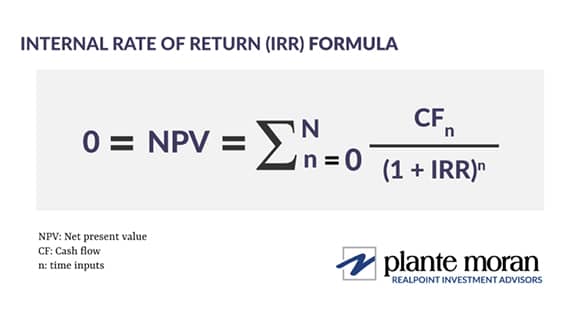
So, what is IRR? Mathematically, IRR is the discount rate at which the NPV of all future cash flows equals zero. The appropriate IRR, or “discount rate,” for each project will depend on the project and each investor’s risk tolerance. Generally, riskier projects require a higher IRR to compensate investors for the opportunity cost of investing in them rather than in a less-risky project that may yield a lower IRR. In the example above, an investor who can earn 5% per year with little risk would be indifferent to investing in a project with the same risk profile that yields a 5% IRR, because it would neither destroy nor create value in their portfolio.
How IRR is calculated
The math behind IRR follows the formula pictured below. This formula calls for NPV to be zero (as mentioned above) and includes cash flow (CF) estimates and time inputs (n). With those in place, you then solve for the IRR.
In order to appreciate the IRR equation and how it accounts for the timeline of a project, it’s also helpful to understand how IRR changes over the life of a real estate project.
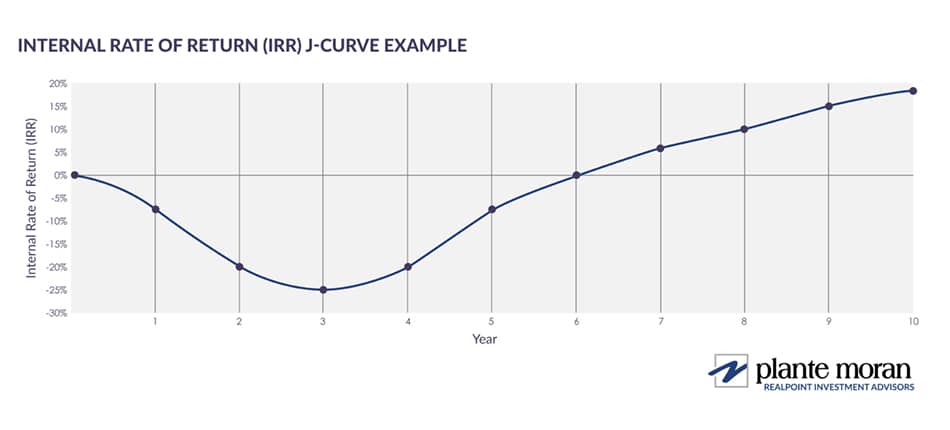
At first, as money is being invested, the IRR will begin as an extremely negative number. As capital is returned, the IRR becomes less negative until finally, when 100% of the initial capital and its corresponding time value is returned, the IRR will equal 0%. IRR then becomes increasingly positive as each additional distribution in excess of the time value of money is received. This change in IRR over time is referred to as the “J-curve,” and is illustrated below.
IRR vs. cash-on-cash return vs. cap rate
Unlike the cap rate or cash-on-cash return, which are metrics to evaluate performance at a particular point in time, IRR is an annualized rate of return. It is designed to take into account the time value of money, measuring performance across multiple time periods over the life of an investment. As a result, IRR can be significantly impacted — positively or negatively — by the passage of time (or lack thereof).
IRR can only indicate your return relative to the project timeline. IRR cannot tell you the absolute dollars earned on an investment. This is where another return metric, the multiple of invested capital, complements the IRR.
IRR vs. multiple of invested capital
Real estate investors may frequently hear the saying, “You can’t eat IRR.” This refers to the fact that for some investors, multiple of invested capital (MOIC, or equity multiple) is more meaningful because it represents the total dollars earned on their original investment versus the more theoretical IRR.
Unlike IRR, the formula for understanding equity multiple is very intuitive. It is the sum of all cash flows and distributions received from a project divided by the invested cash. For example, if you invested $100, received $10 each year for three years, and sold your investment for $120 in year three, your multiple would be 1.5x ($10 + $10 + $10 + $120 divided by your $100 investment). Stated simply, the investor multiplied their initial investment by 1.5.
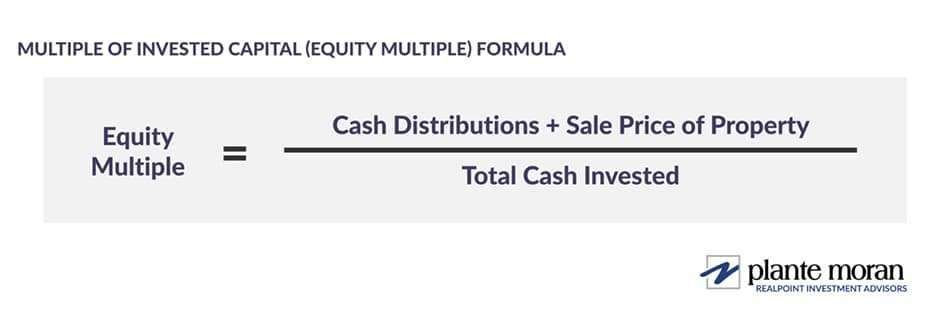
Whereas IRR is intended to take into account the time value of money and present an unlevered annualized return, MOIC is a return metric irrespective of the time value of money or the total duration of the investment. Therefore, it is important to compare the multiple against the IRR when evaluating an investment’s total performance.
For instance, projects with a short life cycle may have very high IRRs but low multiples. On the other hand, projects with longer lives may have lower IRRs and high multiples. This is a function of the time value of money.
By way of example, a project where just the investment is returned (invest $100, receive $100 back) would have a 0% IRR and a 1.0x multiple. It gets even more deceptive when time is involved. A project generating a 30% IRR over two years should have an equity multiple of approximately 1.6x. However, a different project generating a 12% IRR over five years should also have a multiple of approximately 1.6x.
Of the final two examples above, which one would be the better investment? The answer depends. These two projects may have the same multiple, but their respective IRRs indicate very different levels of inherent risk. The decision to buy a property should factor in investor risk appetite, property location, property condition, NOI growth potential, and other investment-specific factors. Also consider other return metrics, such as cash-on-cash return and cap rate, as they can paint a broader picture of the opportunity.
Conclusion
The real estate industry is full of technical formulas for return metrics that can help you evaluate the performance of current or prospective real estate investments. However, these numbers shouldn’t be viewed in a silo, and often need to be scrutinized to determine whether they accurately reflect the investment potential.
Unsure whether a real estate investment opportunity aligns with your personal investment goals? Our real estate investment advisors can work with you to evaluate potential acquisitions and pair that analysis with broader market insights and investment planning. Please reach out with questions — we’d be happy to help.
In the meantime, if you liked this article, consider signing up to have others just like it sent to your inbox.
Opinions expressed in this article are current as of the date of this article, and are subject to change at any time.
Plante Moran Realpoint Investment Advisors (PMRIA) and Plante Moran Wealth Management publish this content to convey general information about our services. Investments and strategies mentioned herein may not be appropriate for you. Past performance does not guarantee future results. All investments include risk and have the potential for loss as well as gain. You should consult our representatives for advice regarding your own situation.


