
Among the relationships that religious institutes navigate, their relationship with property is one of the most complex and emotionally charged for both leaders and members.
Your properties are not just real estate holdings. They’ve been your homesteads, and they hold your history. They conjure collective meaning and shape communal memories. They’re cherished sacred spaces and holy ground. All of that is true.
What is also true is that the buildings and land that were once abuzz with activity and life may now represent more of a burden than a blessing and present more problems than purpose.
As you discern the future of your properties, wading through the questions and complexities related to property concerns can be overwhelming. One place to start is to consider the ways in which you are in relationship with your property and to consider which, if any, of those relationships are essential for your needs.
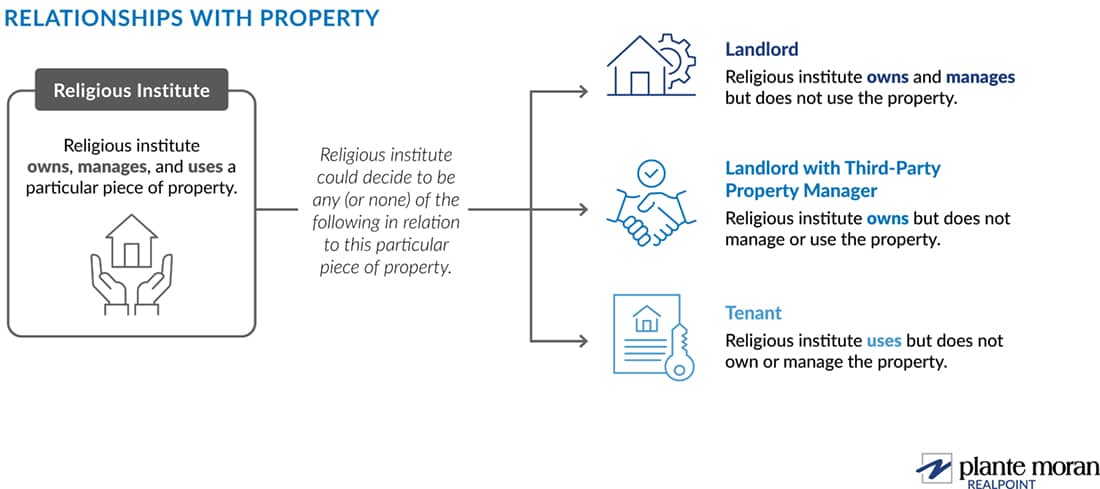
The bullets and illustration below depict the basic relationships that religious institutes often have with property and options for consideration as you discern the nature of the relationship with property that can best serve you now and into the future.
- An owner, you’re responsible for its long-term care and decisions, perhaps leasing the space to others, and thus becoming a landlord.
- A manager, you’re overseeing its day-to-day functioning.
- A user, you’re living and/or ministering in the space, but not owning or managing, thus becoming a tenant.
You may be in one, more than one, or all of these relationships with a single piece of property, or you may have varied relationships with various pieces of property.
Each relationship holds benefits and obligations. The nature of your relationships with your property indicates the scope and nature of the benefits and obligations that belong to you. The more relationships you have with a particular piece of property, the more complex your benefits and obligations are. Assessing benefits and obligations in light of your current and future needs and circumstances will help clarify next steps and considerations.
The remainder of the article provides descriptions of the general benefits and obligations associated with various relationships you may have or wish to have with your property. We’ll start with the highest complexity and work our way down to the lowest complexity.
Owner, Manager, and User
This is the most common set of relationships — and the most complex — that religious institutes have with their property. You own the property, manage the upkeep of the property, and make use of the property for your institute’s operations, such as residential, health care, and ministry activities.
Benefits:
- You maintain full control and autonomy over the property’s use, users, management, and stewardship decisions.
Obligations:
- You maintain full liability and responsibility for stewardship, management, maintenance, and planning.
- Typically, there is an assumption of full costs, such as capital, maintenance, management, insurances, and more.
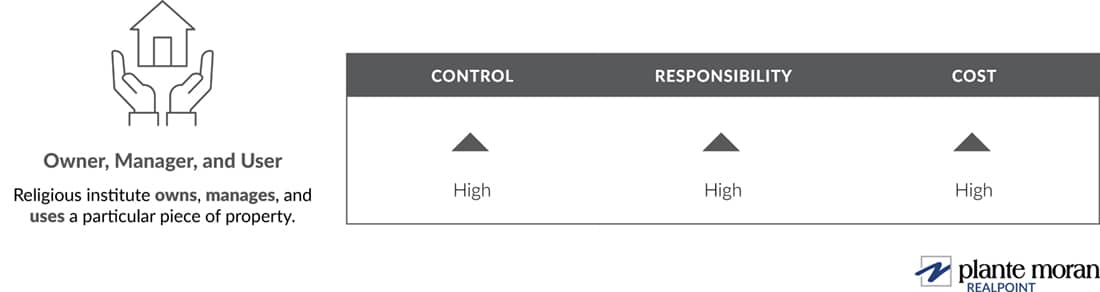
Based on this information, the following graphic summarizes the relative control, responsibility, and costs of the “Owner, Manager, and User” relationship.
Owner and Manager (not User) = Landlord
This is an example of a set of relationships an institute may have with property when it seeks to maintain certain controls or oversight over leased property. This arrangement may be desirable for property that accommodates shared space or multiple users, or property that the institute may share with another user.
Benefits:
- You maintain ownership, desirable management control, and appropriate oversight as per the terms of the lease.
- The property becomes a revenue stream as per the terms of the lease, and you retain the possibility of generating funds should you choose to sell the property.
Obligations:
- You retain management and oversight responsibilities, including associated costs, but how much varies depending on the terms of the lease.
- Typically includes the cost of capital maintenance and improvements, and some, if not all, insurances.
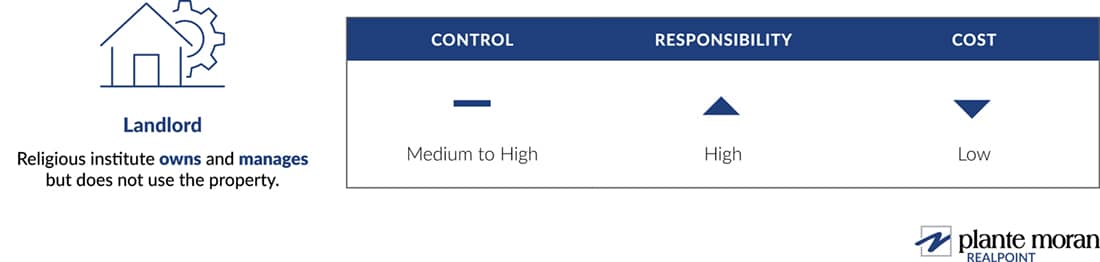
Based on this information, the following graphic summarizes the relative control, responsibility, and costs of the “Landlord” relationship.
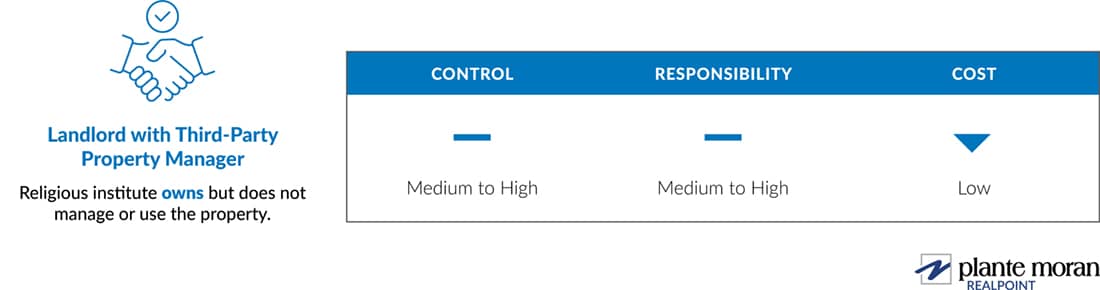
Owner (not User or Manager) = Landlord with Third-Party Manager
This is a relationship that religious institutes may have with leased property used by sponsored ministries, ministry activities, or other users aligned with the institute’s mission, vision, and values. You own the property, but your institute does not use the property for its own operations, nor do you manage the property. Depending on the management contract in place, you could have little or no responsibility to manage the upkeep of the property. In this relationship, a third-party manager should align with your mission, vision, and values.
Benefits:
- You maintain ownership while assigning the desired obligations to the lessee as per the lease agreement and to the third-party manager as per the management contract.
- An absolute net lease or bondable lease typically assigns all obligations to the lessee for the length of the lease.
- You also may structure a lease or a management contract to maintain some desired control. In that case, you will likely maintain any associated obligations.
- The property becomes a revenue stream as per the terms of the lease, and you retain the possibility of generating funds should you choose to sell the property.
Obligations:
- Varies depending on the terms of the lease and management contract.
- You provide oversight of a third-party property manager, including any associated costs as per the management contract.
Based on this information, the following graphic summarizes the relative control, responsibility, and costs of the “Landlord with Third-Party Manager” relationship.
User Only (Tenant)
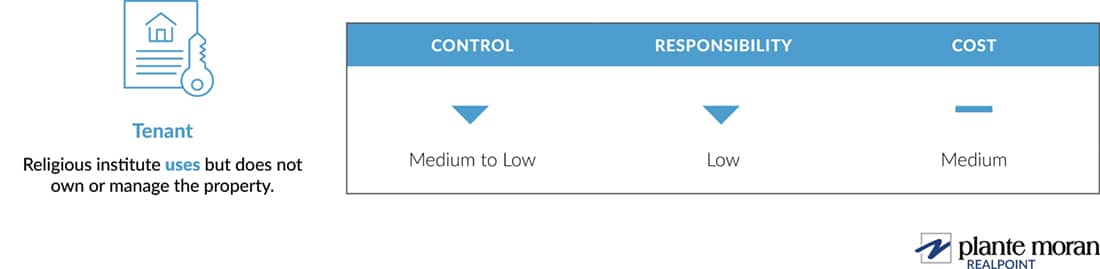
The simplest relationship would be that of a user only, or a tenant. This usually represents a relationship that an institute may have with residential property (e.g., motherhouse or senior living) that it once owned, has transitioned to another owner (and manager), and now leases back from the new owner for use by members. This type of transaction is called a sale-leaseback. The terms of use are typically designated in a lease or another legal agreement with the new owner.
Benefits:
- You maintain the desired use of the property as per the terms of the lease or agreement.
- Eliminates costs and obligations associated with ownership and management (see above).
Obligations:
- Varies depending on the terms of the lease.
Based on this information, the following graphic summarizes the relative control, responsibility, and costs of the “Tenant” relationship.
Comparison of relationship options
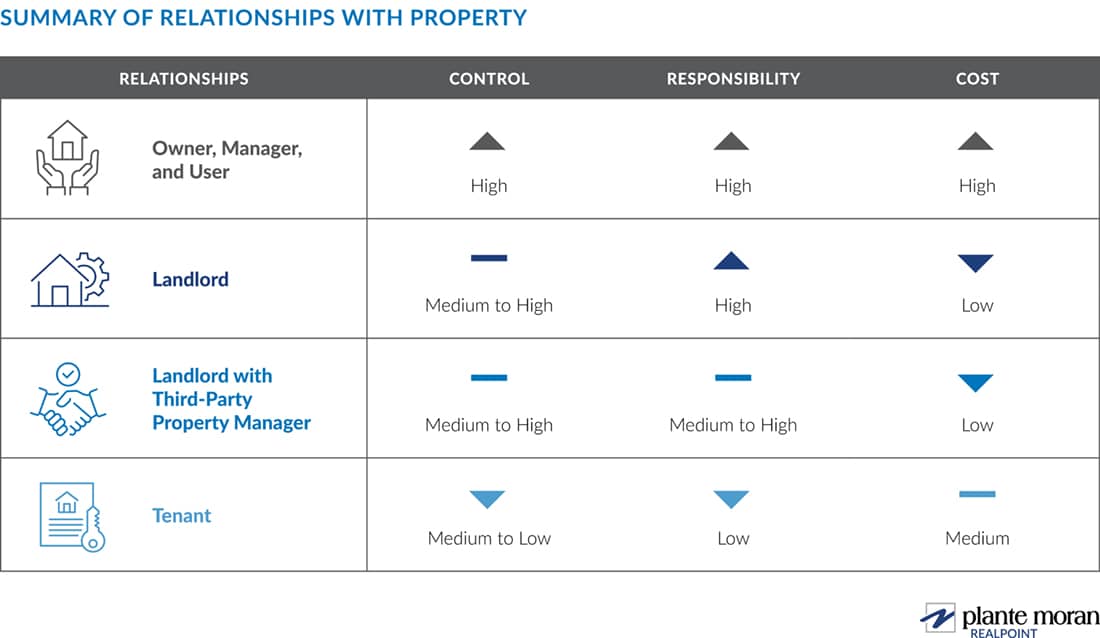
To facilitate comparison, the graphic below summarizes each relationship, including relative control, responsibility, and costs. A religious institute may choose any of these roles for the property or none at all.
Enabling decision-making amidst emotion
We recognize that responding to the topics in the resource in fruitful and meaningful ways will involve a variety of conversations and could surface an array of emotions among leaders and members. We are available to support and accompany you in that process.
We have accompanied many leaders and communities through discernment, direction-setting, and decision-making related to all sorts of properties, including motherhouses, schools, healthcare facilities, residential spaces, and vacant buildings and land. As you look to address your questions or concerns about property, consider reaching out to us for consultation and support.
Download the relationship with property worksheet
While looking at these scenarios in writing may seem straightforward, the reality of navigating the relationship with property is often logistically and emotionally complicated. As you begin to explore your institute’s relationship with property, we have designed a resource with questions, considerations, and conversation-starters. We hope this tool can assist you as you begin to untangle some of the complexities of your institute’s relationship with property.


