

The bottom line? Sentiment improving but still subdued
- A five-month high in consumer sentiment reflects some relief in near-term inflation expectations as the easing of tensions in the Middle East, at least temporarily, pulled gas prices down from their recent highs.
- The prospects for continued improvement have taken a hit in recent weeks as diplomatic efforts faltered and the conflict reignited.
- It’s still a consumer economy that remains characterized in part by the corrosive effect of inflation on spending and by an increasing bifurcation of its impact across the income spectrum.
By the numbers: Current conditions and expectations rebound
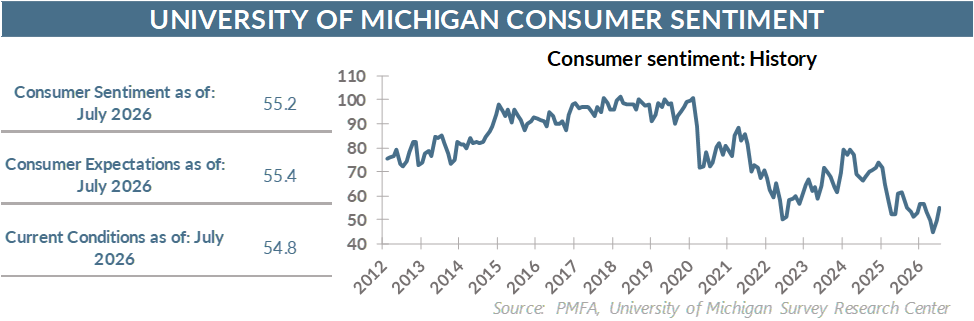
- The University of Michigan’s Consumer Sentiment Index rose to 55.2 in July, extending its upward bounce from May’s historically low reading of 44.8.
- Both components of the index, which span consumer assessments of both current conditions and expectations, displayed meaningful improvement over the past month, suggesting a notable sense of relief for consumers.
- The headline index result remains well off the most recent peak of 74.0 reached in December 2024. The recent improvement notwithstanding, the sustained erosion in the collective consumer mood has persisted for more than a year and a half — an unusually long period in the absence of recession.
Broad thoughts: It’s the K-shaped economy
- A range of factors have affected the consumer experience in recent years that have, in turn, weighed on measures of confidence.
- Geopolitical, economic, and policy uncertainty have been unusually high, and uncertainty alone creates a sense of relative caution even in the absence of feared outcomes becoming reality.
- When uncertainty is high, perceived risk increases, and confidence is diminished.
- On the surface, one would expect sentiment to be stronger than it is with the economy near full employment and layoffs running at or near a historically low level amid a decent growth trajectory.
- But the consumer story is also one of an economy that hasn’t been defined by a rising tide lifting all boats in recent years. The cumulative impact of inflation created a headwind for all consumers but one that’s been much more impactful for lower- and middle-income households.
- Inflation serves as a regressive tax — and one for which the impact is magnified for those already living paycheck to paycheck. In recent years, the outsized impact of inflation on housing, food, and gasoline prices, all staples that represent larger portions of spending for lower-income housing, significantly impaired purchasing power for a large percentage of American households.
- Lower inflation doesn’t reverse the impact of previous price increases; it simply helps to stem the bleeding. Many consumers are still playing catch up and finding ways to stretch their budgets further. It’s the long trail of prior inflation that continues to weigh heavily.
- Recent improvement in sentiment reflects in part the perceived ratcheting back of geopolitical risk in the conflict with Iran and some relief in gas prices since May.
- The recent escalation in the conflict has already pushed crude oil prices higher since the beginning of the month, lifting prices at the pump as well. If that continues, the recent resurgence in sentiment may prove short-lived.
Past performance does not guarantee future results. All investments include risk and have the potential for loss as well as gain.
Data sources for peer group comparisons, returns, and standard statistical data are provided by the sources referenced and are based on data obtained from recognized statistical services or other sources believed to be reliable. However, some or all of the information has not been verified prior to the analysis, and we do not make any representations as to its accuracy or completeness. Any analysis nonfactual in nature constitutes only current opinions, which are subject to change. Benchmarks or indices are included for information purposes only to reflect the current market environment; no index is a directly tradable investment. There may be instances when consultant opinions regarding any fundamental or quantitative analysis may not agree.
Plante Moran Financial Advisors (PMFA) publishes this update to convey general information about market conditions and not for the purpose of providing investment advice. Investment in any of the companies or sectors mentioned herein may not be appropriate for you. You should consult a representative from PMFA for investment advice regarding your own situation.


