

First, the bottom line: A bad result, but not as bad as it looks
- It was a big downside surprise for retailers in July — notably in part because expectations weren’t high to begin with. Even so, underlying factors that weighed on top-line results are more likely to be temporary than a sign of a more prolonged deterioration in household spending.
- Acknowledging some noise in the underlying data, soft retail results over the past few months suggest that consumers are still grappling with the impact of high prices and managing their spending to get the most out of their hard-earned dollars.
- Looking ahead, prices at the pump may act as a litmus test for consumer sentiment and their ability to spend. The ebb and flow of the Middle East conflict is not only creating volatility in gas prices, but also in the collective consumer mood. That’s unlikely to change any time soon.
By the numbers: A swing and a miss
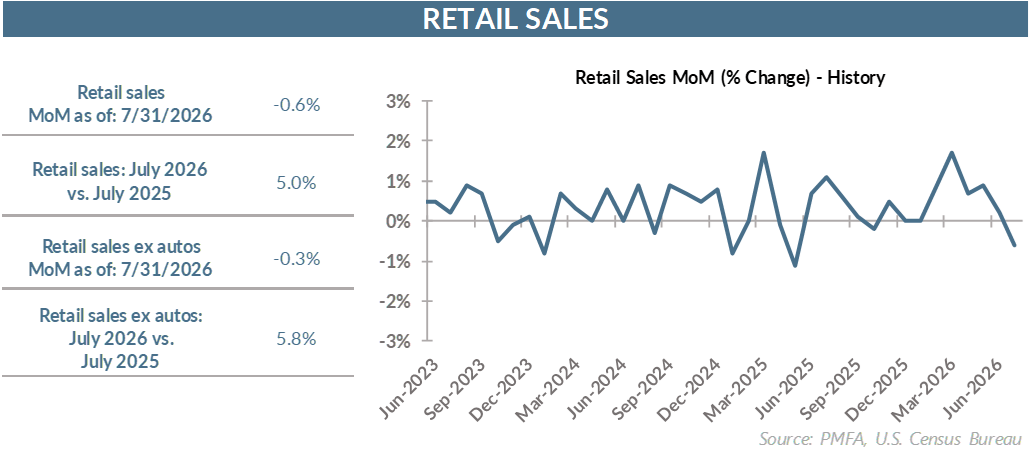
- Retail sales declined by 0.6% in July, falling well short of a modest 0.1% expected increase, while leaving June results unchanged at a 0.2% gain.
- Automobile sales were weak, sliding by 2.0% for the month — a decline that also pulled the 12-month change down to a tepid 1.4%.
- Nonstore retailers, a category dominated by online commerce, saw an outsized monthly decline of 2.2% — an unusually poor but explainable result for a key source of growth in the retail sector.
- Gas station sales were off 0.9% — a “bad news is good news” result on the back of falling gas prices during the month.
- Despite the overall negative tone, there were a few positive pockets for the month. Restaurant sales increased by 0.5%, which (coupled with effectively flat grocery store sales) suggest that consumers were comfortable spending a bit more to go out to eat.
- Clothing stores also posted a strong 1.9% monthly gain, likely lifted by early back-to-school shopping.
Lots of noise in the monthly data, but inflation remains the major consumer challenge
- Forecasts for the July retail report were constrained; economists were expecting any sales gain to be modest at best. The results failed to meet even that relatively low bar.
- Coming off a solid string of retail sales gains from February through May, momentum was relatively strong coming into the summer. Since June, retailers have had to tread water against a consumer backdrop that’s been much more tentative.
- An improvement in August wouldn’t be surprising though. Underlying the monthly data is some noise that should stabilize, eliminating at least one notable headwind present in the July data.
- Amazon’s decision to move its annual Prime Day event to June from July pulled forward those sales by a month. The impact was readily apparent in the unusually weak 2.2% monthly decline for nonstore retailers after a decent 0.9% June increase. With that in the rear-view mirror, August sales should be set up for a moderate reversal that may provide some lift to top-line results as well.
- Persistent volatility in energy prices remains a key challenge for consumers as prices at the pump rise and fall with developments in the Middle East conflict.
- Lower gas prices in June and early July provided a bit more wiggle room for other household spending last month, but that could be a greater challenge in August if the recent surge in prices persists.
- On a relative basis, fuel prices are well off their May peak, but they’ve still risen by nearly a dollar per gallon over last year, more than enough for consumers to feel the pinch.
- Households are also still showing signs of caution overall, with most measures of the collective consumer mood remaining somewhat negative. Changes in survey methodology in recent years may be skewing data to the downside to a degree, but even factoring that in, recent gauges of sentiment are still consistent with a consumer base that’s more uneasy than would typically be the case in a growing economy with low unemployment.
- Inflation continues to be the primary challenge, with the collective impact of price increases in recent years being more impactful than the very recent — and more measured — pace of increase.
- It’s inflation that’s eroding purchasing power to varying degrees for all consumers, limiting spending growth despite solid labor conditions and wage gains that would otherwise provide ample fuel for spending.
- That’s the source of frustration for consumers, the primary focus for the Fed, and a growing risk for many in Washington D.C. that will return home to face frustrated voters in advance of the rapidly approaching November midterm election.
Past performance does not guarantee future results. All investments include risk and have the potential for loss as well as gain.
Data sources for peer group comparisons, returns, and standard statistical data are provided by the sources referenced and are based on data obtained from recognized statistical services or other sources believed to be reliable. However, some or all of the information has not been verified prior to the analysis, and we do not make any representations as to its accuracy or completeness. Any analysis nonfactual in nature constitutes only current opinions, which are subject to change. Benchmarks or indices are included for information purposes only to reflect the current market environment; no index is a directly tradable investment. There may be instances when consultant opinions regarding any fundamental or quantitative analysis may not agree.
Plante Moran Financial Advisors (PMFA) publishes this update to convey general information about market conditions and not for the purpose of providing investment advice. Investment in any of the companies or sectors mentioned herein may not be appropriate for you. You should consult a representative from PMFA for investment advice regarding your own situation.


