

Consumers remain wary of inflation and the economic outlook
- Consumers remain in a rather sullen mood but are at least showing signs of trying to regain their footing in June.
- The recent spike in gasoline prices — and resulting strain on household budgets for many Americans — was a major blow to sentiment. More recently, the sharp decline in fuel prices nationally has been a source of relief, even if limited.
- Consumers are still wary of what the recent surge in energy prices means for inflation more broadly, with memories of the COVID-19 era price surge still fresh. If it persists, stickier inflation is bound to chew further into discretionary spending, particularly for lower- and middle-income households.
By the numbers: Lower gas prices boost current outlook and expectations
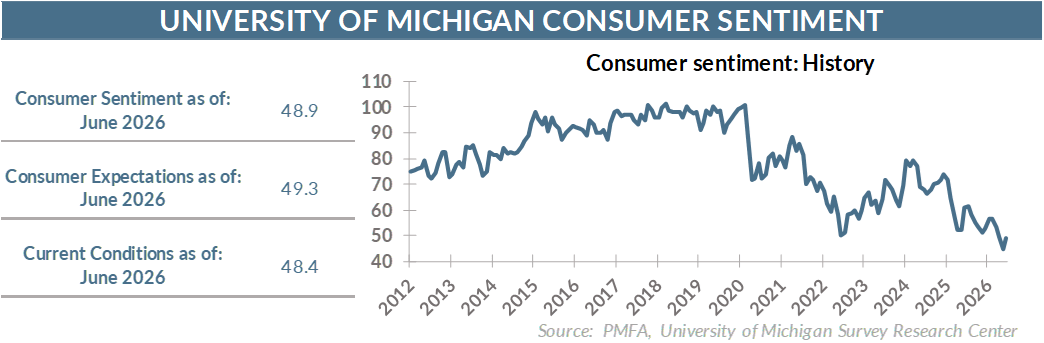
- The University of Michigan’s Consumer Sentiment Index improved moderately to 48.9 in the preliminary June ready, up from the May’s final index level of 44.8.
- The June uptick suggests that consumers are beginning to pick themselves after being hit hard by the impact of surging energy prices this spring, which in turn caused already elevated inflation to accelerate in recent months. The reality of higher prices at the pump also reignited concerns that a second inflationary wave could be building. The recent release of the May consumer price index report validated those concerns.
- Notably, both components of the consumer sentiment index bounced back in June, indicating that consumers were seeing some tangible improvement in real time that also filtered through to provide a moderate lift in their very restrained expectations for the economy in the coming months.
Broad thoughts: A recessionary mood in a growing economy
- The improvement in the collective mood notwithstanding, consumers remain quite negative in their overall outlook on the economy, with inflation playing a considerable role.
- Economic growth remains on a solidly positive path, but that doesn’t mean that the consumer sector broadly feels good about their spending power. Wage growth remains solid and layoffs remain low — two factors that typically bode well for measures of sentiment and spending. The rest of the story — particularly focused on how far those dollars can be stretched — is more challenging.
- The average consumer continues to feel pressure on multiple fronts, including service sector inflation, housing affordability, and higher interest rates, all of which represent sources of frustration or worse even in a solid labor economy. Goods inflation has eased, but that doesn’t translate to prices coming down, just greater stability on a relative basis.
- It’s the dichotomy between top-line growth and the individual consumer experience that helps to explain why sentiment remains deeply in territory typically seen during recessions, not expansions.
- The bottom line? It may be a growth economy, but it doesn’t feel like one for many consumers.
Past performance does not guarantee future results. All investments include risk and have the potential for loss as well as gain.
Data sources for peer group comparisons, returns, and standard statistical data are provided by the sources referenced and are based on data obtained from recognized statistical services or other sources believed to be reliable. However, some or all of the information has not been verified prior to the analysis, and we do not make any representations as to its accuracy or completeness. Any analysis nonfactual in nature constitutes only current opinions, which are subject to change. Benchmarks or indices are included for information purposes only to reflect the current market environment; no index is a directly tradable investment. There may be instances when consultant opinions regarding any fundamental or quantitative analysis may not agree.
Plante Moran Financial Advisors (PMFA) publishes this update to convey general information about market conditions and not for the purpose of providing investment advice. Investment in any of the companies or sectors mentioned herein may not be appropriate for you. You should consult a representative from PMFA for investment advice regarding your own situation.
.jpg?la=en&h=307&mw=480&w=480&hash=B3933C39F4E8A96C36E339BFF108FEA0)

