

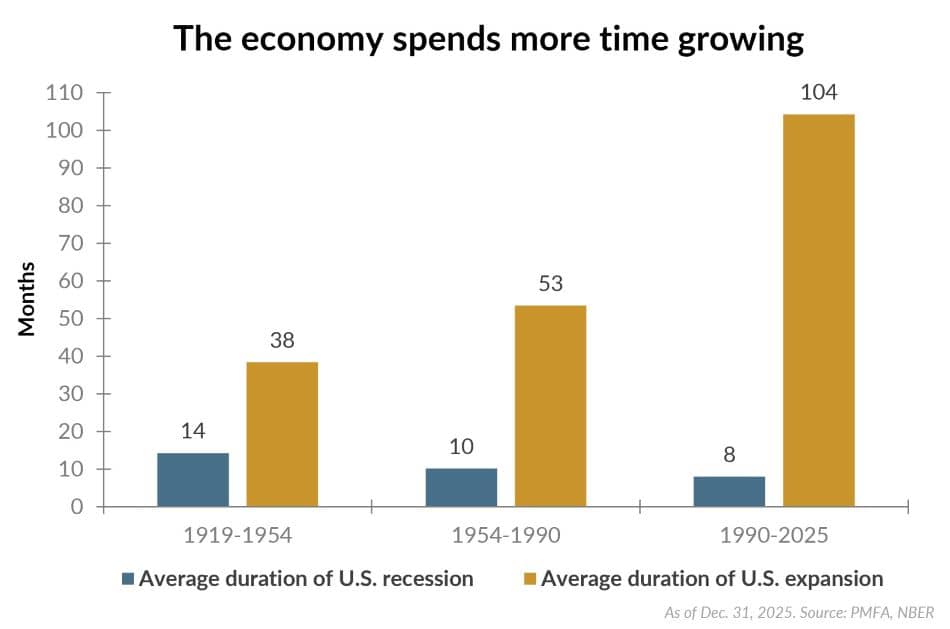
An examination of over a century of U.S. economic history reveals a striking trend: recessions have become shorter and less frequent, while expansions have grown longer. From 1919 to 1954, the average recession lasted over 14 months. Since 1990, that duration has shortened to just eight months. Meanwhile, expansions have stretched from an average duration of 38 months to more than 104.
While not the only factor, this change reflects a fundamental evolution of the U.S. economy. Over time, economic activity has become increasingly diversified and less dependent on highly cyclical industries. Services now account for the majority of economic output, reducing the economy’s sensitivity to inventory swings, manufacturing slowdowns, energy price spikes, and other traditional sources of cyclical economic volatility. Further, advances in technology, improved access to information, and a more responsive policy framework have helped businesses, consumers, and policymakers adapt more quickly to changing economic and financial conditions.
Economic cycles haven’t disappeared, and recessions are still an unavoidable part of the economic cycle. However, the balance of time the economy spends in expansion versus contraction has changed considerably. Despite elevated interest rates, geopolitical uncertainty, and periodic bouts of market volatility, the U.S. economy has remained remarkably resilient. Healthy consumer spending, a solid labor market, and strong corporate profitability have continued to support economic growth, underscoring the importance of benefits of a disciplined, long-term investment approach.
Past performance does not guarantee future results. All investments include risk and have the potential for loss as well as gain.
Data sources for peer group comparisons, returns, and standard statistical data are provided by the sources referenced and are based on data obtained from recognized statistical services or other sources believed to be reliable. However, some or all of the information has not been verified prior to the analysis, and we do not make any representations as to its accuracy or completeness. Any analysis nonfactual in nature constitutes only current opinions, which are subject to change. Benchmarks or indices are included for information purposes only to reflect the current market environment; no index is a directly tradable investment. There may be instances when consultant opinions regarding any fundamental or quantitative analysis may not agree.
Plante Moran Financial Advisors (PMFA) publishes this update to convey general information about market conditions and not for the purpose of providing investment advice. Investment in any of the companies or sectors mentioned herein may not be appropriate for you. You should consult a representative from PMFA for investment advice regarding your own situation.


