

First, the bottom line: Back to “no hire, no fire”
- The July report flips the recent narrative of a labor market that appeared to be firming. A combination of net job losses in July and surprisingly large downward revisions to previously reported gains now show that hiring has lost momentum in recent months despite exceptionally low layoffs.
- Admittedly, the numbers don’t seem to fully square with the claims data and the underlying resurgence in consumption in recent months. Some noise in the seasonal adjustments may be negatively skewing the data to a point, but the report still suggests that the economy is seemingly slipping back toward the “no hire, no fire” narrative that characterized the labor market through much of 2025.
By the numbers: A softer hiring environment
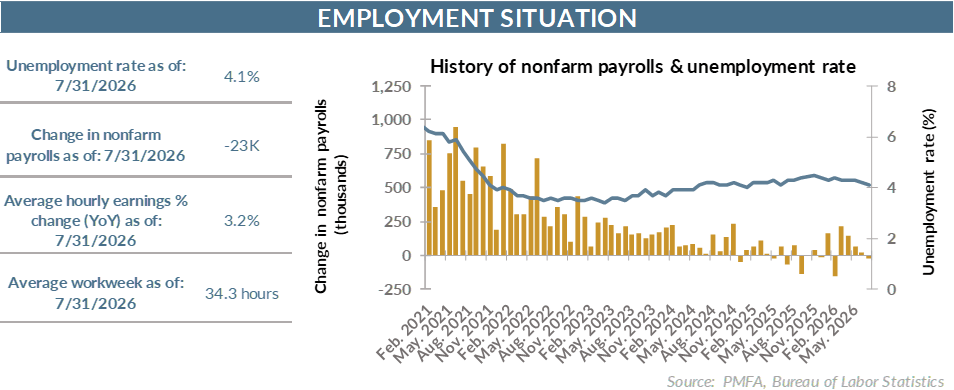
- Nonfarm payrolls declined unexpectedly in July, falling by 23,000 in July — well below the consensus forecast for a gain of around 80,000 for the month.
- Downward revisions to May and June payrolls further magnified the weakness in hiring, slashing over 100,000 off previously reported estimates and reining in the three-month average payroll gain to a lackluster 20,000.
- Despite the softer hiring environment, unemployment edged lower to 4.1%, a direct reflection of continued erosion in labor force participation. With fewer workers, either employed or looking for work, a lower unemployment rate reflects a smaller labor pool rather than a strong hiring environment. Either can reduce the unemployment rate, but the underlying causes — and what it means for the economy — are very different.
- That softer hiring environment also carried through to a more pedestrian pace for wage growth. Average hourly earnings moved very little, allowing some easing in the 12-month increase to 3.2%. That’s the softest print since early 2021 and a sign that wage pressures continue to recede back toward pre-pandemic norms.
Broad thoughts: It’s a “bad news is good news” Friday
- The July jobs report provided additional ammunition for Fed doves that have thus far tipped the scales toward staying the course in the Warsh Fed. This comes despite the mounting concerns about inflation and the risk that it could become more deeply rooted in the economy and in expectations. The change in leadership within the Fed, its marked change in communication style, and intentional opaqueness around its near-term policy views have further muddied the waters for Fed watchers.
- Both on the surface and in the details, there’s very little in the July jobs report that reflects strength, but a broader array of employment data still paints a more mixed picture.
- The jobs report suggests that the economy is reverting back toward a “no hire” backdrop, while ongoing claims data indicates that the “no fire” environment remains intact.
- It’s also important to note that July payrolls were heavily influenced by nearly 50,000 jobs lost in education, much of which is likely to be reversed as students return and schools rehire teachers. Even so, the seasonality of education employment is only an exacerbating factor in the report, not a compelling explanation for the notable deceleration in hiring.
- Against an otherwise gloomy report, softer wage growth should loosen the screws a bit for the Warsh Fed, which has been under increasing scrutiny in many corners for its decision not to raise its short-term policy rate despite stubbornly sticky inflation. Weaker wage growth doesn’t take a rate hike in the coming months off the table but should relieve one source of inflationary pressure and potentially provide policymakers with a bit more runway to monitor conditions and assess the need for tighter policy.
- If sustained, wage growth in this range isn’t inconsistent with a 2% inflation target, so long as productivity gains can be sustained.
- Early market reaction to the report reinforces the “bad news is good news” narrative, with long rates coming in and equity futures hooking higher. The best case for the markets is a benign decline in inflation toward the Fed’s 2% target in the absence of rate hikes. Today’s report doesn’t hurt in that regard, although other inflation catalysts will likely need to cool further as well.
- For now, the potential for a rate hike before year-end is intact, but softer labor conditions and weaker wage growth buttress the case for holding steady for a bit longer.
Past performance does not guarantee future results. All investments include risk and have the potential for loss as well as gain.
Data sources for peer group comparisons, returns, and standard statistical data are provided by the sources referenced and are based on data obtained from recognized statistical services or other sources believed to be reliable. However, some or all of the information has not been verified prior to the analysis, and we do not make any representations as to its accuracy or completeness. Any analysis nonfactual in nature constitutes only current opinions, which are subject to change. Benchmarks or indices are included for information purposes only to reflect the current market environment; no index is a directly tradable investment. There may be instances when consultant opinions regarding any fundamental or quantitative analysis may not agree.
Plante Moran Financial Advisors (PMFA) publishes this update to convey general information about market conditions and not for the purpose of providing investment advice. Investment in any of the companies or sectors mentioned herein may not be appropriate for you. You should consult a representative from PMFA for investment advice regarding your own situation.


