

First, the bottom line: Unhappy consumers are still spending
- Consumers might not be happy about high prices, but that frustration didn’t crush their ability to spend.
- Consumer spending rebounded alongside emerging signs of potential stability in housing. If consumption growth can be sustained, the economy won’t be as reliant on the single engine of business investment to keep the economy aloft.
- If anything, the fact that discontented consumers continue to spend suggests that — to paraphrase Mark Twain — any rumors of their proverbial death as a primary economic engine were exaggerated.
By the numbers: Solid, but unspectacular, GDP masks underlying consumer strength
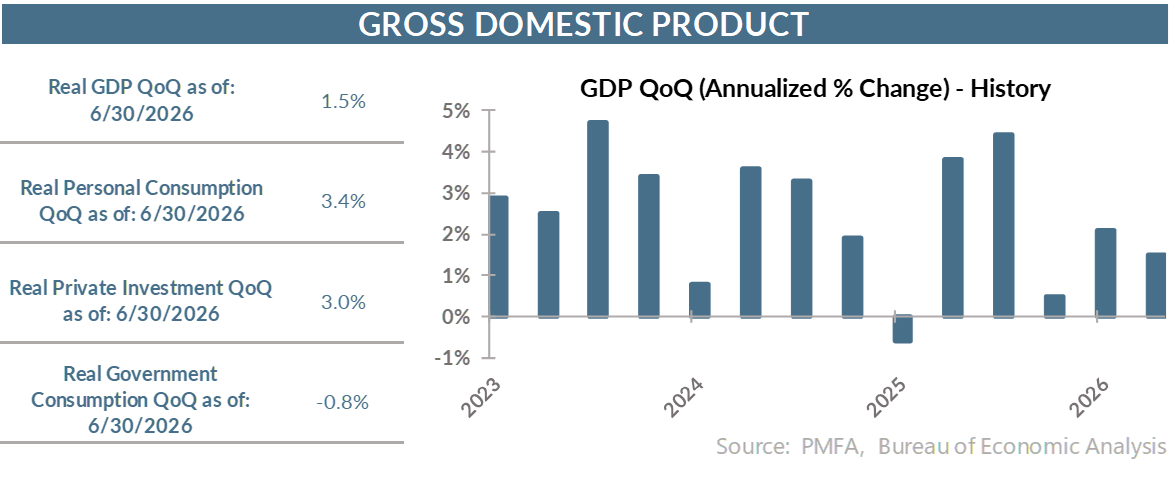
- The U.S. economy expanded at a 1.5% annualized pace in the second quarter, a decline from the 2.1% pace in the first quarter, but in line with the consensus forecast coming into the report.
- Real final sales to private domestic purchasers — perhaps the cleanest read of underlying private sector demand — rose by a brisk 4.2%, revised up from an initial reading of 3.9%.
- A one-two punch of inventory depletion and a widening trade gap weighed significantly on headline growth, slashing 1.9 percentage points off the top line, masking an otherwise encouraging consumption story.
- Personal consumption expenditures grew at a crisp 3.4% as consumers opened their wallets a bit more freely on goods and services alike.
- Business investment also advanced at a firm 7.0% pace, with AI-related investment again leading the way.
- Adding to a more constructive consumer story, housing returned to positive territory, albeit only modestly, after five consecutive quarters of contraction.
- Government spending moderated, with reductions in federal nondefense spending more than offsetting increases on defense and at the state and local level.
Inflation is still a concern, but the consumer mood is worse than their spending
- It may seem like a contradiction in terms, but consumers — long frustrated by a multiyear stretch of high inflation — are understandably frustrated by high prices, but still able to absorb them and seemingly willing and able to spend.
- Personal consumption expenditures gained momentum in Q2, spanning nondurable goods and services, but also extending into a solid gain in higher-ticket durable goods. That’s not the result one might expect against a backdrop of subdued consumer sentiment and tighter household budgets.
- Other data suggests that Q2’s solid consumption growth could be well positioned to fuel further positive momentum in the coming quarters. July reports on personal income and spending both topped expectations, although inflation-adjusted spending was flat. Personal income growth (0.4%) for the month outpaced the increase in spending (+0.2%), suggesting that households broadly may be rebuilding a bit more wiggle room in their budgets and topping off savings.
- Further, the outsized drag from the trade deficit and shrinking inventories may not weigh as significantly on top-line growth in coming quarters. That alone has the potential to reduce one significant headwind present in Q2.
- However, the downside risk of elevated inflation remains problematic, confirmed by today’s release of the July PCE price index. Both headline and core (ex-food and energy) indexes rose by 0.2% for the month, which superficially appears relatively benign. The trailing 12-month increases of 3.7% and 3.3% for headline and core consumer inflation respectively reaffirm its persistent stickiness and corrosive effects on consumer spending power.
- While increasingly a rearview mirror story, the Q2 GDP data still provides some meaningful context about the state of the economy coming into midsummer and the apparent dichotomy between how consumers feel and what they are doing.
- A range of consumer surveys still point to a relative mood of discontent, with inflation still the primary culprit. Despite that, solid consumption has reasserted itself as the main driver of growth last quarter.
- That doesn’t mean that all households are participating in the spending recovery. The K-shaped backdrop of a bifurcated consumer economy is still intact. High-income households have fared comparatively well, with spending lifted in part by rising asset prices. Low-income households haven’t fared as favorably as inflation has surged, with food and housing prices — both of which represent larger parts of their monthly spending than for the average household — increasing considerably in recent years.
- Boil it down and a clearer story begins to emerge. Adjusted for inflation, real growth moderated in Q2 despite resurgent consumption and greater stability in housing.
Past performance does not guarantee future results. All investments include risk and have the potential for loss as well as gain.
Data sources for peer group comparisons, returns, and standard statistical data are provided by the sources referenced and are based on data obtained from recognized statistical services or other sources believed to be reliable. However, some or all of the information has not been verified prior to the analysis, and we do not make any representations as to its accuracy or completeness. Any analysis nonfactual in nature constitutes only current opinions, which are subject to change. Benchmarks or indices are included for information purposes only to reflect the current market environment; no index is a directly tradable investment. There may be instances when consultant opinions regarding any fundamental or quantitative analysis may not agree.
Plante Moran Financial Advisors (PMFA) publishes this update to convey general information about market conditions and not for the purpose of providing investment advice. Investment in any of the companies or sectors mentioned herein may not be appropriate for you. You should consult a representative from PMFA for investment advice regarding your own situation.


