

The bottom line: September is a live meeting for the Fed
- While his preferred communication style appears to focus on brevity over clarity, Warsh’s bottom line at Jackson Hole was still telling: “We must be confident that underlying inflation is moving to our objective, clearly and at sufficient speed. Otherwise, we have work to do.”
- Don’t be surprised if the Fed’s rate decision next week comes with their metaphorical sleeves rolled up. With labor conditions still firm and evidence that the prior disinflationary trend may be stalling, the probability of a quarter-point rate hike next week just increased.
- September is a live meeting for the Fed.
By the numbers: Headline inflation is tame, but the problem is in the core
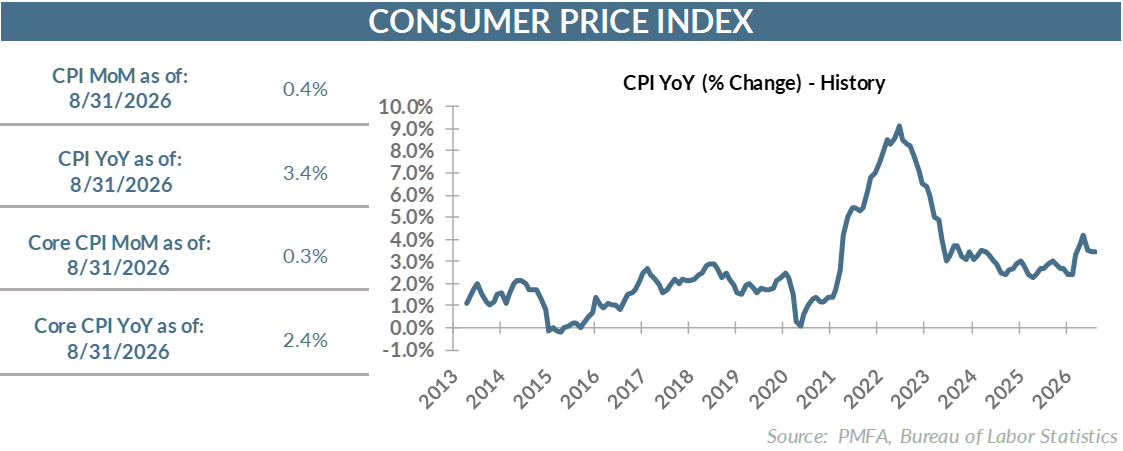
- The consumer price index rose by 0.4% in August, in line with the consensus forecast.
- Core CPI, which excludes food and energy, increased by 0.3%, a tick hotter than consensus expectations for a 0.2% increase.
- On a year-over-year basis, headline CPI held steady at 3.4%, while core CPI moderated fractionally to 2.4%.
- Gasoline prices shot up 2.1% in August and appear poised to rise further in September on the back of the recent surge in crude oil prices. That outsized increase has more than offset food prices, which have moved little in recent months.
- Shelter inflation increased by 0.3% — noteworthy because of its prominent weight within the index. It’s also more indicative of underlying inflation trends than highly volatile gas prices, which has skewed headline inflation to the upside this year.
Next up: The Fed
- Not surprisingly, a sharp uptick in gasoline prices was a considerable contributor to the reacceleration in headline inflation, having risen by 2.1% in August. It’s also a catalyst that appears poised to extend into September’s reading as crude oil prices have surged in recent days.
- Gas prices have risen by 28% over the past year, a source of frustration for consumers who feel the pinch every time they fill their tanks and a very visible reminder of the impact of the Middle East conflict on the American public.
- From a monetary policy perspective, the importance of energy prices is lessened by its volatility. That alone isn’t likely to play a significant role in the Fed’s rate decision next week. More notable is the acceleration in monthly core inflation, which showed some signs of being tamed earlier in the year. The 0.3% rise in core inflation in August was the largest monthly increase since Warsh’s return to the Fed. Its impact may be softened a bit by the fractional decline in trailing 12-month core inflation to 2.4%. It’s possible — if not likely — that policymakers may put a bit more weight on the recent data than the trailing 12-month increase, particularly given indications that disinflation has been losing momentum for some time.
- Coming on the heels of his hawkish tone in his comments at the Jackson Hole Fed event, it raises the stakes for the September FOMC meeting and should shed more light on where Warsh’s breaking point is between his historical preference for lowering rates and the reality of current conditions. His assessment at Jackson Hole was that the summer inflation readings indicated that underlying trends hadn’t meaningfully improved. August data certainly didn’t do anything to dispel those doubts.
- One could reasonably avoid characterizing the August inflation data as hot, but it’s at least warm and not headed in the direction Fed policymakers would like to see if they deemed prior months’ data to be unsatisfactory. As a result, the August FOMC meeting just became a bit more interesting. What the market knows is that Fed Chair Warsh is committed to charting a new course for Fed, while reaffirming its core mandate of price stability and its 2% target as its bogey. What’s less clear is how policymakers are assessing the current situation and what the specific catalysts or triggers will move the Fed to act.
- To this point in the Warsh regime, he’s been content to create some intentional ambiguity, stepping back from the forward guidance and relative transparency that has helped to define the philosophy of the post-financial crisis Fed. Instead, the Fed has relied increasingly on hawkish jawboning around inflation and allowing — if not encouraging — market forces to push rates higher across the curve, consequentially tightening financial conditions without budging on the Fed’s policy rate.
- With August measures of core inflation coming in warmer than would ideally be the case, the Fed’s decision next week looms even larger than it did before. Will their broad reading of economic conditions remain sufficiently benign for them to hold steady for now, or will the moderate reacceleration in inflation represent a tipping point that nudges them to hike? That’s the question. If policymakers choose to stand pat again, the questions surrounding what they’re waiting for will become louder and more direct.
Media mention:
Our experts were recently quoted on this topic in the following publication:
Past performance does not guarantee future results. All investments include risk and have the potential for loss as well as gain.
Data sources for peer group comparisons, returns, and standard statistical data are provided by the sources referenced and are based on data obtained from recognized statistical services or other sources believed to be reliable. However, some or all of the information has not been verified prior to the analysis, and we do not make any representations as to its accuracy or completeness. Any analysis nonfactual in nature constitutes only current opinions, which are subject to change. Benchmarks or indices are included for information purposes only to reflect the current market environment; no index is a directly tradable investment. There may be instances when consultant opinions regarding any fundamental or quantitative analysis may not agree.
Plante Moran Financial Advisors (PMFA) publishes this update to convey general information about market conditions and not for the purpose of providing investment advice. Investment in any of the companies or sectors mentioned herein may not be appropriate for you. You should consult a representative from PMFA for investment advice regarding your own situation.
.jpg?la=en&h=307&mw=480&w=480&hash=B3933C39F4E8A96C36E339BFF108FEA0)

