

First, the bottom line: It’s a “good news” jobs report
- Payroll gains had been soft in recent months, but the pillars of low unemployment and limited layoffs provided some reassurance of relative stability within the labor economy. August’s unexpectedly strong payroll gains and upward revisions to prior months help to validate the bigger picture of a labor market that remains on a solid growth trajectory.
- Coupled with sticky, elevated inflation, the August jobs report delivered fuel for inflation hawks within the Fed that have been calling for rate hikes. With the August CPI report now on deck, the question is whether the combined impact of stronger-than-expected hiring and a stiff inflation tailwind will push policymakers to the tipping point of raising rates later this month.
By the numbers: Better than expected payrolls underpinned by improving hiring breadth
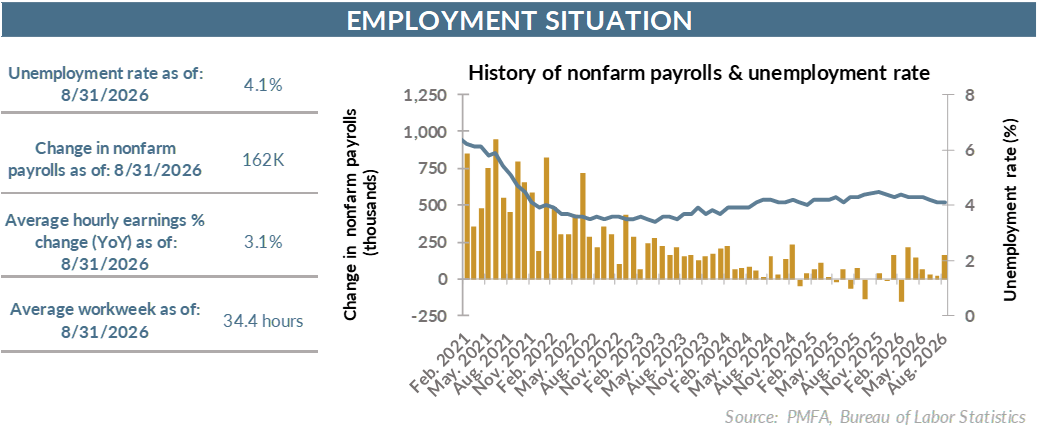
- Nonfarm payrolls landed much more strongly than expected, rising by 162,000 in August, crushing expectations for a modest bounce on the heels of July’s negative print.
- The gain in payrolls was widespread, spanning goods production, services, and government jobs. Notably, it wasn’t concentrated narrowly in a few sectors as has been the case during extended stretches over the last year.
- Leisure and hospitality gains were constructive, as were gains in healthcare — two sectors that have contributed significantly to job creation of late as other parts of the economy have lagged.
- Still, solid gains in manufacturing, construction, government, and other parts of the service economy suggest a broadening in hiring that points to more balanced labor demand.
- Revisions to previously released June and July payrolls tacked an additional 55,000 jobs onto the strong August print.
- The unemployment rate held firm at 4.1% as expected, while labor force participation edged up by 0.2% to 61.6%.
- Average hourly earnings rose by 0.3% in August and at a 3.1% pace over the past year. Wage growth has cooled considerably in recent years but is still advancing at a pace that’s supportive of consumption growth.
Labor and inflation data are increasingly clearing the path for Fed rate hike
- Unemployment around 4% is a good indication that the economy is still operating near or at full employment, although the full picture is less definitive.
- A modest uptick in labor force participation augments the full employment argument at the margin, but participation has still fallen by 0.7% over the past 12 months.
- The headline unemployment data also doesn’t account for individuals who may be employed, but in a role that doesn’t align with their skills or career focus. The best example may be in information services, with unemployment running close to 6% as a combination of AI adoption, expanded capital investment, and the industry’s hiring binge earlier in the decade casts a long shadow over hiring demand.
- Even so, the pockets of weakness that are evident are limited. More broadly, it’s a solid labor economy — one in which hiring is less brisk than was the case a few years ago, but also one in which layoffs are limited, and labor force growth is comparatively constrained.
- What will this mean for the Fed? It certainly makes the case for a rate hike in September more compelling. A three-month average payroll gain of about 71,000 may look modest compared to recent years, but labor force growth has also meaningfully slowed. Against that backdrop, job creation in the recent range is sufficient to keep unemployment in check and labor conditions relatively tight.
- Fed policymakers can now wait for the August report on consumer prices as the last big shoe to drop before the September rate policy meeting. A solid employment print provides some reassurance that a quarter-point rate hike is justified viewed through the lens of their dual mandate.
- As Fed Chair Warsh continues to refine his tone, he also appears to be trying to open the door for a near-term rate hike while remaining committed to a more measured, less transparent form of communication.
- Of particular note was his observation at Jackson Hole that “it’s hard to say that Fed policy is restrictive when you look at the economy right now.”
- With Warsh’s reaffirmation of the Fed’s 2% inflation target and an acknowledgement that inflation remains a primary concern, it increasingly appears that a rate hike may be a matter of when, not if, although the August CPI report will be critical.
- That’s being priced into futures markets, which now estimate a 60% probability of a hike later this month, and in the yield curve, which steepened at the short end this morning after the jobs data dropped.
- Whether the Fed will deliver in September remains to be seen, but with inflation showing no real signs of meaningfully abating, the questions will inevitably focus on if not now, when and what precisely policymakers need to see to take that step.
Past performance does not guarantee future results. All investments include risk and have the potential for loss as well as gain.
Data sources for peer group comparisons, returns, and standard statistical data are provided by the sources referenced and are based on data obtained from recognized statistical services or other sources believed to be reliable. However, some or all of the information has not been verified prior to the analysis, and we do not make any representations as to its accuracy or completeness. Any analysis nonfactual in nature constitutes only current opinions, which are subject to change. Benchmarks or indices are included for information purposes only to reflect the current market environment; no index is a directly tradable investment. There may be instances when consultant opinions regarding any fundamental or quantitative analysis may not agree.
Plante Moran Financial Advisors (PMFA) publishes this update to convey general information about market conditions and not for the purpose of providing investment advice. Investment in any of the companies or sectors mentioned herein may not be appropriate for you. You should consult a representative from PMFA for investment advice regarding your own situation.
.jpg?la=en&h=307&mw=480&w=480&hash=B3933C39F4E8A96C36E339BFF108FEA0)

