

The bottom line: Hot or not?
- There were no real surprises in the July report on consumer inflation — and that’s good news given expectations for the report were fairly pedestrian.
- Two benign months alone don’t make a trend, setting up the August CPI report as a critical one that could either confirm a sustained moderation in inflation or renew concerns that inflation remains frustratingly sticky.
- On a trailing basis, inflation is still running high but has shown clear signs of moderation in recent months. Call it encouraging with an asterisk.
- So, is inflation hot or not? It depends on how you slice the data — and that distinction will matter to Fed policymakers as they renew their debate over rate policy next month.
By the numbers: Modest gains in line with forecasts
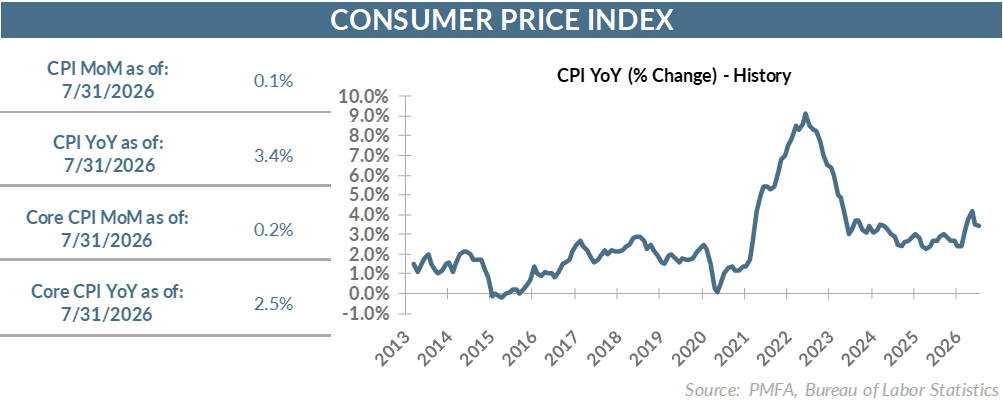
- The consumer price index edged fractionally higher in July, rising by just 0.1% for the month, while core CPI, which excludes food and energy, rose by 0.2% Both were in line with the consensus forecast coming into the report.
- The moderation in the monthly gains also filtered through to the 12-month index readings, with headline CPI easing to 3.4% and core declining to 2.5%.
- Under the hood, key components of the report also trended in a positive direction.
- The sharp decline in gas prices early in the month reined in energy inflation for a second consecutive month on a 1.5% decline.
- Food prices edged fractionally lower but have been relatively flat over the past three months.
- Shelter costs are also finally showing some signs of meaningful moderation, coming in at a mere 0.1% gain for the second consecutive month.
- The most notable outlier was medical care services, which posted an unusually high 0.6% gain for the month while its trailing 12-month increase remained comfortably below the broad index over that period.
Directionally positive with further progress needed
- In isolation, the July inflation data is about as benign as one could hope for. Stack a few more months like that on top of one another and inflation concerns would recede considerably.
- Tangible signs of a long-anticipated moderation in shelter costs are particularly encouraging given both the magnitude of price increases for housing in recent years and its significance within the index.
- An ebbing in the conflict in the Middle East proved beneficial in July, as oil prices pulled back early in the month as tensions eased. That didn’t hold, and the subsequent reversal in energy prices will filter through into August data if tensions — and the resulting geopolitical premium built into crude oil prices — remain elevated in the coming weeks.
- Even so, the recent easing of price pressures extends well beyond the energy sector, which is good news for consumers who are weary from trying to stretch their spending budgets after a multiyear cycle of price increases unlike any seen in decades. Progress is encouraging, that much is certain, but it’s still insufficient to conclude that a return to a steadier inflation environment is imminent.
- Fed policymakers doubled down last month on their commitment to knocking inflation risk down. The FOMC’s July 29 declaration that “the Committee will deliver price stability” is about as definitive as it could be in terms of resolve, while remaining intentionally vague on a timeline or strategy to do so.
- While somewhat split on the need for immediate rate hikes, the Warsh Fed appears to be content thus far to rely on jawboning and market forces to rein in financial conditions — a strategy that may have worked to a point. It still leaves market participants and Fed watchers mulling what this new and intentionally murkier communication regime will mean for financial markets.
- The Fed’s September meeting has been eyed as a potential “live meeting” for a rate hike, although the futures market is now reflecting a higher probability of another decision to stand pat on rates. The July inflation report gives policymakers a bit more leeway for patience; the August report will be delivered days before the September FOMC meeting, providing a bit more data for them to consider. A third consecutive report suggesting that inflation is tame would probably seal the deal for the Fed to remain patient and stand pat for a bit longer.
- That all measures of consumer inflation remain well above the Fed’s target isn’t a small consideration. The question is how long policymakers will be willing to remain on standby in hopes that a combination of current policy positioning and other market forces will be sufficient for prices pressures to ease in an acceptable time frame.
- With forward guidance quickly becoming a vestige of the policy tool bag of Warsh’s predecessors, it’s a question that may only be answered definitively by actual Fed rate announcements in the coming months.
Media mention:
Our experts were recently quoted on this topic in the following publication:
Past performance does not guarantee future results. All investments include risk and have the potential for loss as well as gain.
Data sources for peer group comparisons, returns, and standard statistical data are provided by the sources referenced and are based on data obtained from recognized statistical services or other sources believed to be reliable. However, some or all of the information has not been verified prior to the analysis, and we do not make any representations as to its accuracy or completeness. Any analysis nonfactual in nature constitutes only current opinions, which are subject to change. Benchmarks or indices are included for information purposes only to reflect the current market environment; no index is a directly tradable investment. There may be instances when consultant opinions regarding any fundamental or quantitative analysis may not agree.
Plante Moran Financial Advisors (PMFA) publishes this update to convey general information about market conditions and not for the purpose of providing investment advice. Investment in any of the companies or sectors mentioned herein may not be appropriate for you. You should consult a representative from PMFA for investment advice regarding your own situation.


