


In some states, policy-driven changes are creating reimbursement advantages that exceed what local wage growth alone would produce, while hospitals in other states face increasing pressure despite underlying wage increases. As a result, hospitals with similar labor cost trends can experience markedly different Medicare reimbursement outcomes depending on where they operate.
Final wage indexes changed materially after the Centers for Medicare & Medicaid Services (CMS) incorporated updated data and finalized reclassification decisions. The most significant impact resulted from the recalculation of rural floor values, demonstrating the impact of reclassification strategies.
The map below illustrates how wage index policy changes are impacting Medicare reimbursement across the country. While some states are benefiting from rural floor dynamics and other policy-driven adjustments, others are experiencing relative pressure under the budget-neutral wage index system. This geographic view helps show why hospitals with similar labor cost trends may see materially different reimbursement outcomes depending on where they operate.
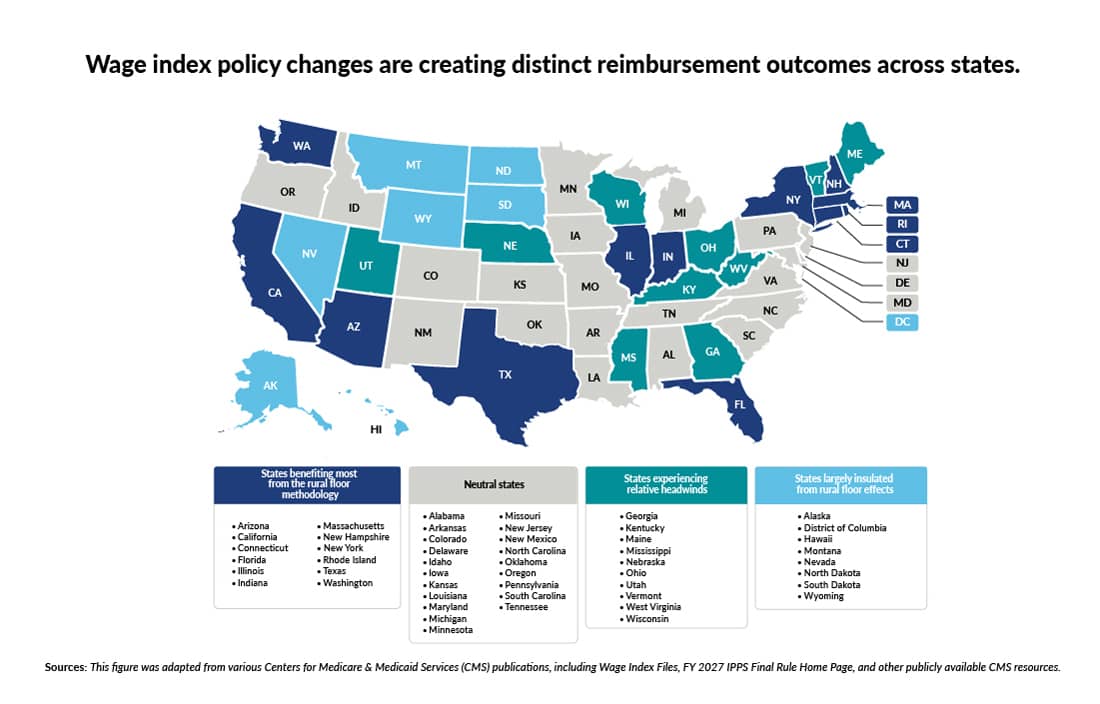
States benefiting most from the rural floor methodology
In these states, high-wage rate urban hospitals have obtained rural status, elevating the statewide rural floor, resulting in wage index values that are meaningfully higher than the state’s underlying wage index calculations would otherwise support.
Neutral states
Some states experience wage index changes that more closely reflect actual changes in labor costs, wage growth, occupational mix, and market competitiveness, rather than rural floor dynamics. Year-over-year fluctuations are generally driven by changes in reported salaries and hours, relative wage growth compared to other states, and the normal recalibration process incorporated into the annual Inpatient Prospective Payment System (IPPS) update.
States experiencing relative headwinds
Several states experienced declining wage index factors despite underlying wage growth. With wage index operating as a budget-neutral system, reimbursement gains in rural floor benefit states can create offsetting pressure in states receiving little or no rural floor advantage.
States largely insulated from rural floor effects
Alaska, Hawaii, the District of Columbia, and the frontier states (Montana, North Dakota, South Dakota, Wyoming, and Nevada) are subject to unique statutory or geographic payment provisions that make their wage index outcomes less dependent on rural floor dynamics.
Downstream impact beyond acute care hospitals
Wage index changes affect substantially more than IPPS payments, including payment rates under:
- Outpatient Prospective Payment System (OPPS)
- Inpatient Rehabilitation Facility PPS (IRF)
- Inpatient Psychiatric Facility PPS (IPF)
- Skilled Nursing Facility PPS (SNF)
Because these payment systems rely upon hospital wage index values, rural floor mechanics impact reimbursement across multiple Medicare payment programs.
CFOs and finance leaders should keep this in mind
Wage index continues to evolve from a technical reimbursement calculation into a strategic financial issue. States benefiting from rural floor policies are increasingly realizing reimbursement advantages across multiple Medicare payment systems, while budget neutrality requirements place offsetting pressure on hospitals elsewhere.
Three questions every CFO should be asking:
- Is our state benefiting from rural floor dynamics?
- How much of our Medicare reimbursement depends on wage index-sensitive payment systems?
- Are our competitors receiving policy-driven reimbursement advantages that we are not?
Understanding where a hospital sits within this landscape is becoming increasingly important as wage index policy, rather than wage growth alone, plays a larger role in shaping Medicare reimbursement outcomes.


