

The bottom line? Durable labor market is clearing the path for further Fed hikes
- Another week of low jobless claims reaffirms the resilience of the labor market and reflects the underlying strength of the near-term economic outlook. At the same time, labor market strength reinforces the growing expectation that the Federal Reserve has ample room to raise rates further until policymakers are convinced that inflation is on a path back to 2% in an acceptable time frame.
By the numbers: The “no fire” labor market rolls forward
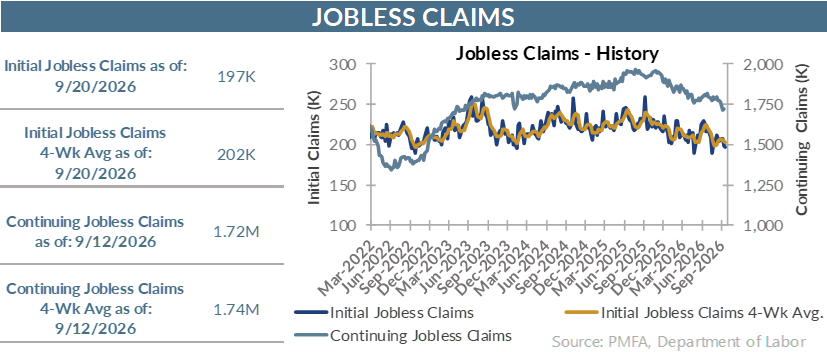
- Initial jobless claims edged lower last week, easing/rising to 197,000 for the week ended September 19 — effectively unchanged from the preceding week’s revised total of 198,000.
- Economists typically look to smooth the impact of weekly claims via the four-week moving average. More recently, the relative stability in the data has limited the need to do so, although the most recent reading also edged lower to 202,250.
- Stepping back from the most recent data, continuing claims also remain in a constructive range at 1.72 million — down about 200,000 from one year prior.
Firm labor conditions underpin Fed’s ability to tighten
- No single data point provides absolute clarity about the state of the labor economy, but jobless claims are valuable not only for their timeliness, but for what they can portend for economic momentum.
- Against the current backdrop, persistently low claims for unemployment reinforce the prevailing characterization of a “no fire” labor market — one in which employers aren’t hiring as aggressively as they were a few years ago but are also not inclined to trim payrolls.
- With other indications of economic momentum gathering steam in recent months, that’s not surprising.
- Beyond claims, other labor market data might look muddy on the surface. The pace of job creation has slowed considerably in recent years. Opportunities for job seekers are certainly more limited than they were a few years ago.
- Offsetting that is the reality of a labor force that’s also not growing at a brisk pace, as the combination of an aging population and reduced immigration have created meaningful headwinds.
- The result is a labor economy that — at a macro level — remains in balance, if not tight. Unemployment is low and seemingly stable, despite slower growth in nonfarm payrolls. That’s a new structural reality for the labor market, not indicative of cyclical weakness that’s likely to lead to rising layoffs.
- The firmness of the labor economy has made the Fed’s decision to focus more aggressively on reining in inflation an easier one.
- The Fed’s decision to raise its short-term policy rate last week wasn’t a surprise, nor was the message that policymakers are firmly focused on delivering price stability.
- The bigger question now is how much tightening will be necessary to convince policymakers that they’ve done enough.
- Coming into the year, markets were pricing in rate cuts; today, expectations continue to evolve, with a growing sense that the Fed will not only tighten further in the coming months but may feel the need to hike rates at each of the two remaining meetings this year. The futures market is now pricing in a 50/50 probability of two hikes before 2027.
- Perhaps the clearest evidence of evolving policy expectations can be found in the Treasury market, with intermediate tenors rising toward 5%.
- Notably, the two-year Treasury yield has surged by about 1.4% since the beginning of the year to about 4.85% this morning.
- The message is clear: Treasury investors view the recent rate hike as only the first step for a Fed that will need to do more to confidently tackle persistently elevated inflation. It also suggests that — absent a more pronounced downturn in growth — the Fed may need to hold rates higher for longer.
Media mention:
Our expert was recently quoted on this topic in the following publication:
Past performance does not guarantee future results. All investments include risk and have the potential for loss as well as gain.
Data sources for peer group comparisons, returns, and standard statistical data are provided by the sources referenced and are based on data obtained from recognized statistical services or other sources believed to be reliable. However, some or all of the information has not been verified prior to the analysis, and we do not make any representations as to its accuracy or completeness. Any analysis nonfactual in nature constitutes only current opinions, which are subject to change. Benchmarks or indices are included for information purposes only to reflect the current market environment; no index is a directly tradable investment. There may be instances when consultant opinions regarding any fundamental or quantitative analysis may not agree.
Plante Moran Financial Advisors (PMFA) publishes this update to convey general information about market conditions and not for the purpose of providing investment advice. Investment in any of the companies or sectors mentioned herein may not be appropriate for you. You should consult a representative from PMFA for investment advice regarding your own situation.


