


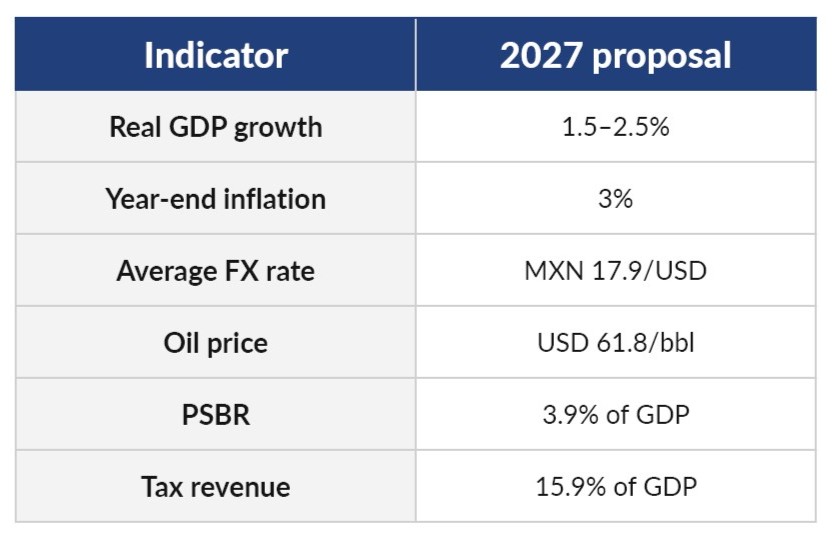
On Sept. 8, 2026, Mexico’s federal government submitted its proposed 2027 economic package to the Mexican Congress. The package outlines the government’s fiscal and tax priorities for the coming year, combining efforts to reduce the fiscal deficit with measures intended to increase tax collection. Proposed changes include new limitations on deductions and net operating losses, adjustments to income tax rules, and investment incentives that could affect U.S. companies operating or investing in Mexico. The package generally doesn’t create new taxes and remains subject to Mexico’s legislative approval process.
The proposal includes several changes that directly affect U.S.-owned companies:
- Minimum taxable profit. A proposed 3.33% floor for companies with revenue above MXN$50 million could affect low-margin subsidiaries.
- Payments to foreign parent. Royalties, service fees and similar payments would be deductible only once they’re paid and the withholding is remitted.
- Intercompany financing. The interest deduction cap would drop from 30 to 20%.
- Loss carryforwards. Their use would be limited to 50% of taxable profit, which means paying more tax earlier in the year.
- Nearshoring incentives. New fixed assets bought from 2027 to 2030 could qualify for immediate deductions.
- Group structures. The Optional Group Regime would be eliminated as of Jan. 1, 2027.
Key proposed income tax changes
1. Control on deductions
For general regime legal entities with revenue above MXN$50 million, a minimum taxable profit of 3.33% is proposed: where deductions exceed 96.67% of taxable revenue, only that percentage would be deductible; where deductions are below that threshold, only 99% would be deductible. Deferred deductions could be used over up to 20 years. The limitation wouldn’t apply to PTU. The measure could function as a minimum income tax burden for low-margin companies, even where their ordinary tax base would be smaller.
2. Net operating losses
The use of prior year NOLs would be limited to 50% of taxable profit for both provisional income tax payments and the annual return. The carryforward period would increase from 10 to 20 years. In practice, applying the limitation to provisional payments may accelerate income tax cash outflows during the year. Companies could owe income tax despite having sufficient prior year tax losses to otherwise offset current profits.
Proposed exceptions would include, among others, taxpayers with less than five years since RFC registration; coordinated and primary sector taxpayers; those applying immediate deductions; maquila operations; taxpayers in bankruptcy proceedings; and certain merger or spinoff cases.
3. Net interest expense
The net interest deduction limitation would decrease from 30 to 20% of adjusted taxable income. Groups with intercompany loans should reassess financing arrangements, forecast nondeductible interest, and review the applicable threshold and group allocation rules.
4. Tax installments
For 2027, an adjustment to the profit coefficient used to determine provisional income tax payments is proposed. The coefficient would be multiplied by 1.0658 when deductions are equal to or below 96.67% of taxable income, and by 2.6162 when deductions exceed such percentage.
Other proposed income tax changes
Foreign payments
Deductions for transactions with foreign residents would be recognized in the fiscal year in which consideration is actually paid and the related withholding tax is remitted. Withholding would follow the earliest of enforceability, accrual, or payment.
Service and lease prepayments
Prepayments would be deductible as the service or use/enjoyment is received or accrued. Multiyear prepayments would be allocated to the corresponding fiscal periods.
CUFIN, CUCA, and debt capitalization
- CUFIN: Certain expenses that fail tax requirements would be included among nondeductible items for UFIN purposes.
- CUCA: Accrued unpaid interest and VAT arising from debt capitalization wouldn’t increase share tax basis or CUCA.
In-kind contributions and accounting losses
Contributions through receivables, collection rights, or credit instruments would increase tax basis and CUCA only when realized and to the extent cash is collected. The amortization of accounting losses would also be treated as a paid reimbursement for certain purposes and would reduce CUCA.
Optional Regime for Groups of Companies
The Optional Regime for Groups of Companies would be eliminated. Existing groups would be required to exit beginning Jan. 1, 2027, and pay deferred income tax under the final transitional rules.
Corporate documentation and governance
The proposed changes involving debt capitalizations, in-kind contributions, CUCA movements, accounting loss amortizations, reorganizations, and the exit from the Optional Group Regime increase the importance of consistency among shareholder or board resolutions, agreements, accounting records, and tax support. Companies should verify that the legal form and corporate documentation of each transaction align with the tax treatment applied.
Initial public offerings (IPO)
A preferential 10% income tax rate is proposed for gains on share dispositions made in connection with an IPO, subject to specific requirements.
Incentives and RESICO
Companies should evaluate eligibility, investment timing, and supporting records before assuming immediate deduction benefits. Any additional incentive for capital repatriation or tax-debt regularization should be addressed only after confirming the operative proposal and eligibility requirements.
Plan México: Productive investment
The income tax law would incorporate immediate deductions for new fixed assets acquired from 2027 through September 2030, with percentages varying by asset and activity, subject to requirements.
Training and innovation
An additional 25% deduction is proposed on the increase in eligible training and innovation expenses compared with the average of the prior three fiscal years.
RESICO: Individuals
The annual threshold would increase from MXN$3.5 million to MXN$5 million; the rate table would be adjusted to maintain the maximum 2.5% rate; reentry would be facilitated for taxpayers who regularize their obligations; and the exempt threshold for certain primary sector activities would rise from MXN$900,000 to MXN$1 million. A simplified 7% VAT option on taxable consideration actually collected, without input VAT credits, is also proposed.
RESICO: Legal entities
The threshold would increase from MXN$35 million to MXN$50 million; the regime would become optional; reentry would be facilitated for companies that again meet the requirements; investment deduction percentages would be expanded and transition mechanisms introduced. The simplified 7% VAT option is also proposed.
Revenue law, digital platforms, VAT, and IEPS
Interest withholding
The annual provisional income tax withholding rate on interest is proposed at 0.68% for 2027, compared with 0.90% in 2026.
Digital platforms: Income tax
The 2027 federal revenue law proposal maintains the withholding regime applicable to digital intermediation platforms. Under the existing framework intended to continue, legal entities selling goods or providing services through such platforms are subject to 2.5% income tax withholding on gross income, with no deductions; where the taxpayer doesn’t provide an RFC, the rate is 20%. The tax withheld may be credited against provisional or annual income tax.
0% VAT: Books, newspapers, and magazines
The proposal would replace the income tax incentive equal to 8% of acquisition cost with a 0% VAT rate on sales, subject to the requirement that 90% of revenue arise from such activity.
Digital platforms: VAT
The VAT withholding framework for digital intermediaries is also maintained. When the platform collects the price and VAT on behalf of the supplier, withholding from legal entities is made under Article 18-J of the VAT Law (generally 50% of the VAT charged). A 100% VAT withholding applies, among other cases, to foreign residents without a permanent establishment in Mexico selling goods in Mexico and where transaction proceeds are deposited into bank or deposit accounts located abroad.
Surcharges and installment payments
Monthly rates would remain at 1.38% on outstanding balances and 2.07% for delinquency. Installment rates would be 1.42% up to 12 months; 1.63% for more than 12 and up to 24 months; and 1.97% for longer terms or deferred payment.
Toll road incentive
The incentive for certain transportation taxpayers would remain, but the annual revenue threshold to qualify would be reduced from MXN$300 million to MXN$250 million.
IEPS: Fuel marketers
Gasoline and diesel marketers other than manufacturers, producers, and importers would compare monthly liters sold against liters purchased. Any positive difference would be subject to IEPS without incentives, reductions or credits, based on Federal Tax Code volumetric controls.


