

First, the bottom line: No warning signs in labor data, but that doesn’t address the inflation elephant in the room
- October’s employment report was a strong one and provides further evidence that the labor market remains on solid footing. Job creation strengthened, prior months were revised higher, unemployment edged lower, labor force participation improved, and wage growth remained healthy. That’s a pretty strong combination of positive developments.
- Today’s jobs report is also consistent with the broader economic picture that has emerged recently: Growth remains solid, and activity across the services and manufacturing sectors remain expansionary.
- Against that positive backdrop, employers still aren’t laying off workers in significant numbers. Initial unemployment claims fell to just 189,000 last week, with the four-week moving average declining to 194,750. That’s the second weekly reading of 189,000 this year — the lowest weekly reading for claims since 1969, when the workforce was less than half the size that it is today.
- At the same time, a strong economy on paper doesn’t necessarily translate into a strong economic mood. Households are still dealing with the cumulative increase in the cost of living over the past several years. One strong jobs report doesn’t materially change those affordability concerns or the significant disconnect that remains between solid economic data and consumers’ perceptions of their own financial circumstances.
- That’s the key distinction that matters and that helps to explain the election results earlier this week. Jobs aren’t the problem. Growth isn’t the problem. Affordability — the cumulative impact of elevated inflation — is the problem.
By the numbers: Much more positive than negative
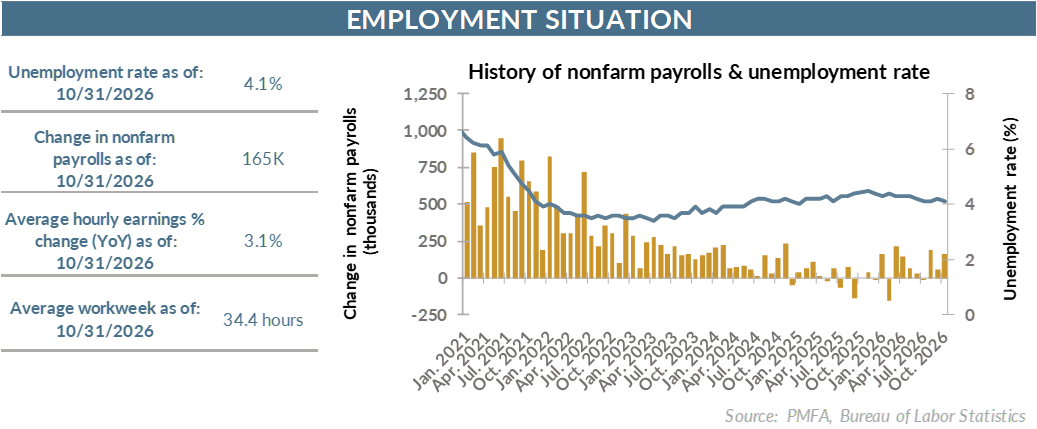
- Nonfarm payrolls increased by 165,000 in October, well above the average monthly gain of just 48,000 over the prior 12 months, and a solid improvement over September’s upwardly revised increase.
- The underlying details built further on the solid headline number. August and September payroll growth were revised higher by a combined 84,000 jobs, lifting the three-month average gain to about 137,000.
- The unemployment rate edged down to 4.1% from 4.2%, keeping that critical barometer of the jobs market in a narrow 4.1% to 4.3% range since March.
- Also notable: The decline in the jobless rate wasn’t the result of workers leaving the labor force. Household employment increased by 463,000, the labor force expanded by 421,000, and the labor force participation rate edged up to 61.9%. While not at the top of the list of important data points in the report, it further reinforces its underlying strength.
- Average hourly earnings increased 0.4% in October and 3.1% over the past year. That’s encouraging for workers, but a factor that the Fed will undoubtedly monitor closely as a signal of undesirably tight labor conditions. While far from the wage gains that accompanied the hypercompetitive labor conditions as the economy was emerging from COVID-19 lockdowns, the potential for wage growth to reaccelerate adds another consideration for Fed policymakers seeking to rein in inflation.
- Job creation was reasonably broad. Professional and business services added 70,000 jobs, healthcare added 42,000, transportation and warehousing added about 25,000, and manufacturing added 19,000. Construction hiring remains weak — a victim of higher interest rates and an uneven environment within the industry.
The labor economy is chugging along, keeping inflation at the forefront for the Fed
- There’s a lot to like in this report. Job creation accelerated, prior months were revised higher, unemployment declined, participation improved, and wage growth remained healthy. While there were some weak spots, nothing significant in the report pointed to a labor market that’s losing its footing.
- Perhaps most encouragingly, the improvement in the unemployment rate was driven by an expanding labor force, not because of discouraged workers simply leaving the labor market. Call it a healthy downtick in unemployment, not a byproduct of unemployed workers giving up and moving to the sidelines.
- From the Fed’s perspective, there’s very little in this report that argues for additional monetary support for the labor market. From a broad perspective, the case for additional rate hikes appears much stronger than the case for standing pat, let alone cutting.
- Still, there remains an important difference between the condition of the economy and how consumers feel about it. That schism was plainly evident in this week’s midterm election results and the unambiguous message from exit polls.
- Inflation has slowed considerably from its peak, but lower inflation doesn’t reverse the cumulative increase in prices households have experienced over the past five years. Consumers don’t experience inflation as an economic statistic. They experience it at the grocery store, in their housing costs, insurance premiums, utility bills, and at the gas pump. Broadly, prices may be rising more slowly, but consumers broadly are still trying to get their heads and wallets around the significant increase in prices across the board in recent years.
- That helps explain why generally constructive economic data haven’t translated into comparable improvement in consumer sentiment. A strong labor market is unquestionably good news, but it doesn’t make the affordability problem disappear. Inflation continues to be the primary challenge for most households; pointing to other strong data as evidence that economic conditions are robust provides no relief.
- Both can be true: At a macro level, the economy is on a solid footing. At a micro level, the foundation under affordability still feels like it’s crumbling. That differentiation goes a long way toward explaining the disconnect between hard and soft data.
Past performance does not guarantee future results. All investments include risk and have the potential for loss as well as gain.
Data sources for peer group comparisons, returns, and standard statistical data are provided by the sources referenced and are based on data obtained from recognized statistical services or other sources believed to be reliable. However, some or all of the information has not been verified prior to the analysis, and we do not make any representations as to its accuracy or completeness. Any analysis nonfactual in nature constitutes only current opinions, which are subject to change. Benchmarks or indices are included for information purposes only to reflect the current market environment; no index is a directly tradable investment. There may be instances when consultant opinions regarding any fundamental or quantitative analysis may not agree.
Plante Moran Financial Advisors (PMFA) publishes this update to convey general information about market conditions and not for the purpose of providing investment advice. Investment in any of the companies or sectors mentioned herein may not be appropriate for you. You should consult a representative from PMFA for investment advice regarding your own situation.


