

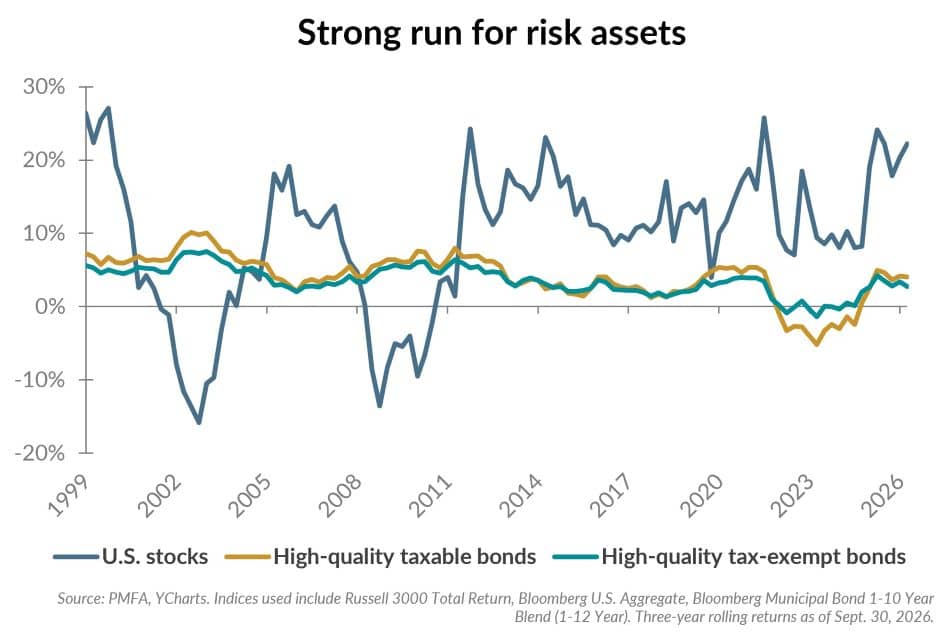
Over the past three years, U.S. equities have had a strong run, delivering returns that are among the strongest for any three-year period since at least the late 1990s. High-quality bonds have also recovered from the sharp reset of 2022, although the strength of the stock market has created a wide performance gap between the two — well beyond what long-term return expectations would suggest.
The recent post-election market volatility provides a timely reminder that equity returns rarely come in a straight line. Market pullbacks or even corrections are a normal feature of investing and reinforce the importance of maintaining discipline in the investment process.
While the strength in equity markets these last few years has been welcome news for diversified investors, it creates the risk that stock allocations are above their intended targets, absent the discipline of rebalancing. Moreover, robust stock market performance creates the risk that investor sentiment toward stocks can become excessively bullish as well, creating the temptation to lean further into stocks than their investment policy — or their risk tolerance — would justify.
At the same time, the fixed-income backdrop has improved, as yields have reset to a range not seen since well before the 2008 financial crisis. Higher income doesn’t eliminate the potential for short-term volatility in bonds, but it provides a much more meaningful cushion against negative returns from further upside in rates, while strengthening the potential contribution of bonds to portfolio returns.
None of this suggests that strong equity performance can’t persist or that investors should attempt to time the market. It’s a reminder though of the importance of periodically reevaluating your asset allocation through a long-term lens. Ensuring that your asset allocation plan remains aligned with your future return needs, risk tolerance, and investment time horizon isn’t a one-time exercise. Over time, making adjustments based on changes in or progress toward your goals is appropriate, as long as the focus remains on the most critical considerations, not based on the emotional tug — either positive or negative — that can arise out of market, economic, or policy developments. recently or what might happen in the near term.
Past performance does not guarantee future results. All investments include risk and have the potential for loss as well as gain.
Data sources for peer group comparisons, returns, and standard statistical data are provided by the sources referenced and are based on data obtained from recognized statistical services or other sources believed to be reliable. However, some or all of the information has not been verified prior to the analysis, and we do not make any representations as to its accuracy or completeness. Any analysis nonfactual in nature constitutes only current opinions, which are subject to change. Benchmarks or indices are included for information purposes only to reflect the current market environment; no index is a directly tradable investment. There may be instances when consultant opinions regarding any fundamental or quantitative analysis may not agree.
Plante Moran Financial Advisors (PMFA) publishes this update to convey general information about market conditions and not for the purpose of providing investment advice. Investment in any of the companies or sectors mentioned herein may not be appropriate for you. You should consult a representative from PMFA for investment advice regarding your own situation.


