

The IPO market is reawakening in a meaningful way. After a multiyear lull in activity, issuance is accelerating alongside strong public equity market sentiment, with expectations now topping $150 to $200 billion in U.S. IPO volume in 2026. What stands out in this cycle, however, isn’t just the rebound in activity but the sheer size and scale of the offerings. SpaceX went public last week at a valuation of about $1.75 trillion, making it easily the largest IPO in history, although only a small fraction of that is actually trading at this point. Other high-profile venture-backed companies such as OpenAI and Anthropic are expected to follow in the coming months with their own debuts, both of which are also expected to generate considerable attention.
Taken together, the pipeline of large private companies poised to enter public markets is estimated to represent $3 trillion or more in market value, although the initial public float (the portion of their stock being actively traded) will likely be a small fraction of that. Even so, this current cycle is shaping up to likely exceed prior peaks in IPO enthusiasm and the aggregate market cap of stocks coming to market. A confluence of favorable conditions supports this backdrop, including robust investor risk appetite driving positive public equity market momentum, considerable enthusiasm for the broad AI theme, and the significant capital needs driven by the rapid growth in AI developments and buildout of compute infrastructure.
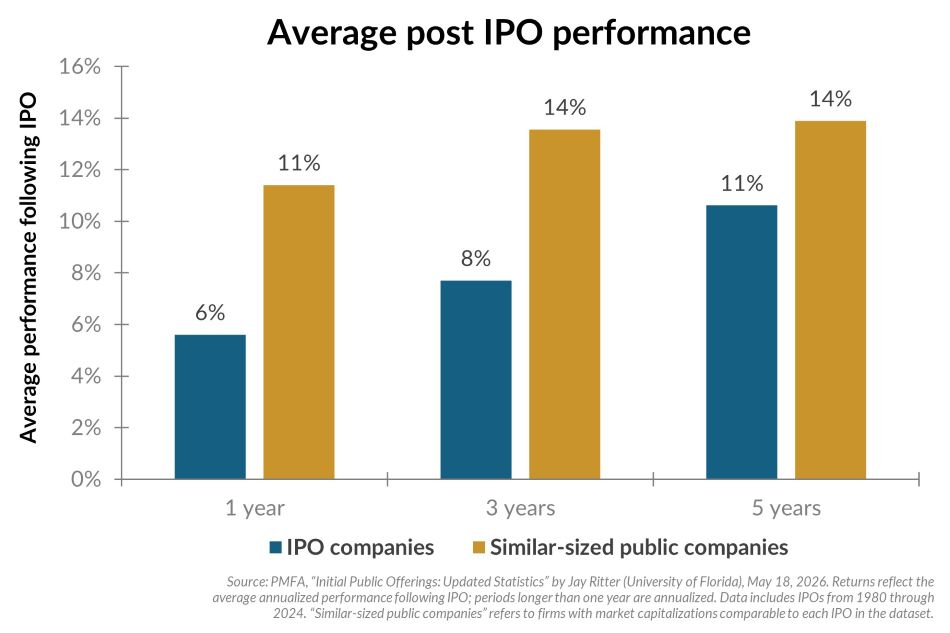
For investors, it’s important to balance this enthusiasm with a healthy dose of historical perspective. While IPOs often deliver strong first-day returns, the average post-IPO performance of new public companies tends to moderate as trading normalizes and valuation discovery unfolds. As illustrated in the accompanying chart, multiyear outcomes have been mixed. On average, IPOs have trailed similarly sized, established public companies over the subsequent one-, three-, and five-year horizons.
That said, averages can obscure as much as they reveal. The range of actual IPO performance over time is highly dispersed, with a small number of exceptionally strong performers providing a boost to average returns, while the majority struggle to meet early expectations and ultimately lag the broad market — sometimes for many years. This dynamic reflects differences in fundamentals, valuation, sector and industry exposure, company maturity, and broader market conditions at the time of listing.
The bottom line is that IPOs can offer compelling opportunities, particularly in periods of innovation-driven growth, but performance for these stocks in the early months and years have generally been unusually volatile, with more laggards than winners on a relative basis.
For investors, any decision to invest directly in such names should be considered thoughtfully, sized appropriately within a diversified portfolio, and aligned with individual investor time horizons and risk tolerance. Even those stocks that have become long-term winners have often taken investors on a rollercoaster ride, requiring a strong tolerance for risk to hang on when price volatility becomes extreme.
Past performance does not guarantee future results. All investments include risk and have the potential for loss as well as gain.
Data sources for peer group comparisons, returns, and standard statistical data are provided by the sources referenced and are based on data obtained from recognized statistical services or other sources believed to be reliable. However, some or all of the information has not been verified prior to the analysis, and we do not make any representations as to its accuracy or completeness. Any analysis nonfactual in nature constitutes only current opinions, which are subject to change. Benchmarks or indices are included for information purposes only to reflect the current market environment; no index is a directly tradable investment. There may be instances when consultant opinions regarding any fundamental or quantitative analysis may not agree.
Plante Moran Financial Advisors (PMFA) publishes this update to convey general information about market conditions and not for the purpose of providing investment advice. Investment in any of the companies or sectors mentioned herein may not be appropriate for you. You should consult a representative from PMFA for investment advice regarding your own situation.


