

First, the bottom line
- While dated, today’s revised data on Q2 growth was even more positive than expected, with accelerating consumption providing the primary lift. It also helps to explain why more recent data on hiring, retail sales, and corporate earnings have been more upbeat than previously released GDP data would have suggested.
- It reinforces what has been apparent in other data in recent months as well: that the economy is on a solid growth trajectory, pushing forward despite the corrosive effects of sticky inflation on consumer spending power.
- With the Fed now shifting to a tightening bias, the economy still appears to have enough positive momentum to absorb some increase in interest rates. Although tighter Fed policy won’t knock down inflation overnight, it also doesn’t appear likely to knock the economy off track either.
- The bottom line? Today’s report doesn’t indicate that the economy is accelerating dramatically and is far from overheating; it confirms that it’s in better shape than prior data suggested and remains much more resilient than many had feared.
By the numbers: The economy is proceeding steadily
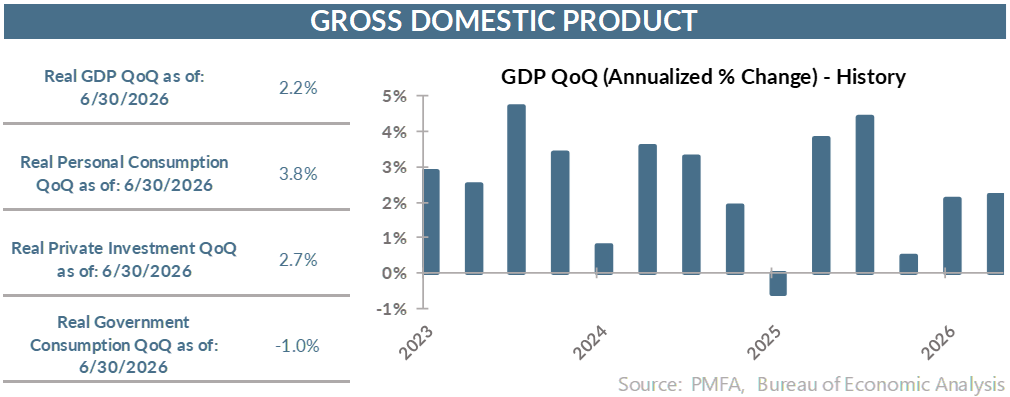
- The U.S. economy expanded at an upwardly revised 2.2% annualized pace in the second quarter, effectively in line with its 2.1% pace in the first quarter of the year. Today’s release painted a much stronger picture than the previously estimated 1.5% pace.
- Personal consumption accelerated significantly in Q2, expanding at a 3.8% annualized pace — its strongest quarterly increase since the final quarter of 2024.
- Business investment — with AI-related capital expenditures leading the way — grew at a crisp 4.6%, providing a second firm pillar under growth.
- Government spending was effectively flat, held in check by a 12.7% decline in nondefense federal spending that sounds worse than it likely was, having increased by 20.7% in the preceding quarter.
Sticky inflation remains a problem for consumers but isn’t dragging the economy down
- With the recent surge in consumption, the economy looks stronger and more balanced. That strength was also readily apparent in the underlying catalysts, led by a 7.4% surge in durable goods purchases. That’s an unexpectedly strong gain given persistent consumer frustration over inflation weighing on sentiment. Consumers who are worried about the economy don’t tend to spend as freely on big-ticket items as they did.
- Therein lies a bit of a dichotomy between what consumers are saying (as evidenced by subdued measures of consumer mood), and what they are collectively doing. Consumers aren’t generally happy, but they’re still willing and able to spend. Some of that disconnect likely reflects the degree to which high-income consumers are driving the surge in spending, while low-income households continue to feel the effect of elevated inflation. Even so, spending growth was strong across durable and nondurable goods and services, suggestive of a broad, solid footing under the consumer sector even against a headwind of elevated inflation.
- A positive print on housing — albeit only modestly so — suggests some degree of stabilization in the housing sector after five consecutive quarterly contractions. Housing affordability remains a major challenge, and one that has been recently exacerbated by increasing mortgage rates. That will dampen near-term homebuyer appetite and could put the stabilization in housing at risk as higher mortgage rates begin to bite in recent months.
- One of the more important takeaways from today’s report is the acceleration in nominal GDP growth (inclusive of both real growth and inflation) over the past six months. Strong nominal GDP growth provides a solid underpinning for corporate revenue growth and has helped to support solid earnings growth for stocks this year.
- It also provides more support for the Fed’s recent decision to hike its policy rate and the potential for additional tightening in the coming months. Real growth is above trend and nominal growth is quite strong; neither are reflective of an economy that’s already on the ropes and is at risk of being knocked down by a few rate hikes.
- Even so, the Fed’s stated goal of returning inflation to their 2% target in an accelerated time frame will remain elusive in the near term. Even if policymakers follow their recent rate hike with more in the coming months, the impact is far from immediate.
- Prior cycles and ample research over time suggest that rate hikes can take up to a year or more to be fully absorbed into the economy. That expectation was also reflected in the Fed’s recently released economic projections, which reflected a forecasted path back to the central bank’s 2% target that extends into 2029.
- Anyone hoping for Fed tightening to solve the inflation problem in the near term is likely to be disappointed. Conversely, anyone fearing that the Fed’s removal of accommodation will push the economy into recession is likely to be pleasantly surprised.
Past performance does not guarantee future results. All investments include risk and have the potential for loss as well as gain.
Data sources for peer group comparisons, returns, and standard statistical data are provided by the sources referenced and are based on data obtained from recognized statistical services or other sources believed to be reliable. However, some or all of the information has not been verified prior to the analysis, and we do not make any representations as to its accuracy or completeness. Any analysis nonfactual in nature constitutes only current opinions, which are subject to change. Benchmarks or indices are included for information purposes only to reflect the current market environment; no index is a directly tradable investment. There may be instances when consultant opinions regarding any fundamental or quantitative analysis may not agree.
Plante Moran Financial Advisors (PMFA) publishes this update to convey general information about market conditions and not for the purpose of providing investment advice. Investment in any of the companies or sectors mentioned herein may not be appropriate for you. You should consult a representative from PMFA for investment advice regarding your own situation.
.jpg?la=en&h=307&mw=480&w=480&hash=B3933C39F4E8A96C36E339BFF108FEA0)

