

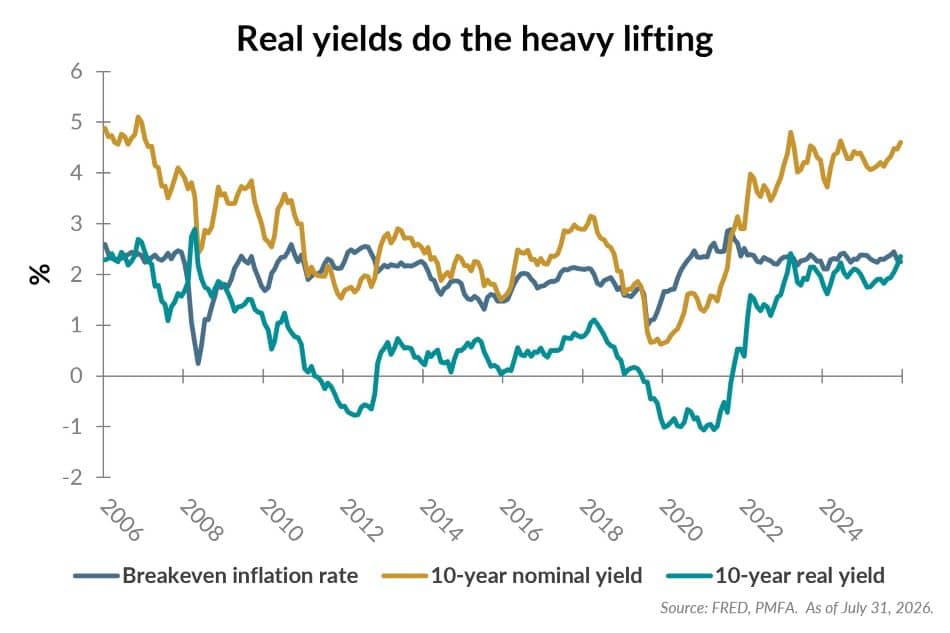
It may seem intuitive to attribute the recent rise in long-term interest rates to inflation, but the evidence suggests otherwise. While the 10- and 30-year Treasury yields have recently risen to levels last seen before 2008, market-based measures of inflation expectations have remained relatively stable. In fact, long-term inflation expectations, as measured by the 10-year breakeven inflation rate, are actually lower today than they were right before the escalation of the conflict with Iran earlier this year.
With 10-year inflation expectations holding firmly around 2.3% while real yields have climbed to a 17-year high, inflation doesn’t appear to be the primary driver. Rather, investors appear to be demanding a higher yield premium for holding long-term treasury bonds.
This recent rise in long-term yields likely reflects a combination of factors, including increased scrutiny over the federal deficits and national debt outlook, substantial debt issuance tied to AI and infrastructure investment, and a less prescriptive communication approach from the Federal Reserve under Chair Warsh. More notably, rising long-term yields have been a global phenomenon, not just a U.S. story. Compared to other developed sovereign debt, Treasurys still hold a yield advantage.
Recent Treasury debt management actions suggest an attempt to moderate long-term yields lower as the Federal Reserve has reduced its direct influence on the bond market. While symbolically meaningful, these measures are modest compared to the Fed’s prior quantitative easing policies and the Treasury market itself.
What does this mean for investors? The obvious question is how much further interest rates could rise. That remains uncertain, but the more important takeaway is that the interest rate environment appears to be reverting toward its pre-2008 norm. While the transition to higher yields has weighed on bond performance, today’s solidly positive real yields present an increasingly attractive opportunity for bond investors. Higher real yields create a forward-looking environment in which bonds can contribute more meaningfully to portfolio returns in real, inflation-adjusted terms.
Past performance does not guarantee future results. All investments include risk and have the potential for loss as well as gain.
Data sources for peer group comparisons, returns, and standard statistical data are provided by the sources referenced and are based on data obtained from recognized statistical services or other sources believed to be reliable. However, some or all of the information has not been verified prior to the analysis, and we do not make any representations as to its accuracy or completeness. Any analysis nonfactual in nature constitutes only current opinions, which are subject to change. Benchmarks or indices are included for information purposes only to reflect the current market environment; no index is a directly tradable investment. There may be instances when consultant opinions regarding any fundamental or quantitative analysis may not agree.
Plante Moran Financial Advisors (PMFA) publishes this update to convey general information about market conditions and not for the purpose of providing investment advice. Investment in any of the companies or sectors mentioned herein may not be appropriate for you. You should consult a representative from PMFA for investment advice regarding your own situation.
.jpg?la=en&h=307&mw=480&w=480&hash=B3933C39F4E8A96C36E339BFF108FEA0)

