

Investors welcome further evidence that the economy continues to cool gradually
- Sometimes bad news is bad news for the markets. Today, that’s not the case.
- Stocks and bonds are both benefiting from news of soft hiring last month. Coupled with better-than-expected consumer inflation data earlier in the week, investors appear increasingly hopeful that Fed policymakers will feel that they’ve sufficient leeway on both sides of their mandate to hold rates steady when they meet later this month.
- Expectations for an October Fed rate hike were quite high just a week ago, but the one-two punch of new inflation and employment data have completely changed the narrative. That doesn’t mean that the Fed is done tightening. It does suggest, however, that investors would welcome a patient approach and — given recent comments from policymakers — there’s growing evidence that they agree.
By the numbers: Underwhelming payrolls in September reinforce “No hire, no fire” labor backdrop
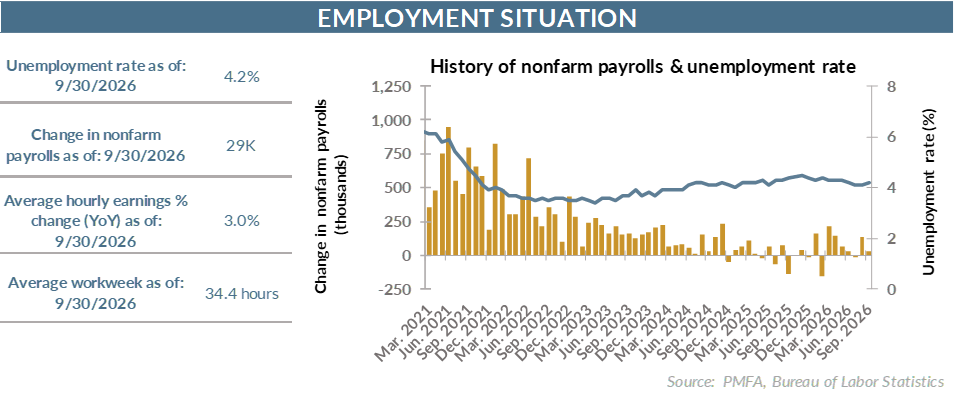
- Nonfarm payrolls increased by 29,000 in September, well below forecasts and a big step down from August’s downwardly revised 133,000 gain.
- The unemployment rate edged up to 4.2%, although the increase was largely attributable to rounding and an uptick in labor force participation rather than deterioration in labor conditions.
- Average hourly earnings edged upward by a meager 0.1% in September, while trailing one-year growth eased to 3%. Wage growth continues to cool off from the post-pandemic bidding war for workers, returning to a range that’s much more in line with the norm before labor markets were severely disrupted by the response to COVID-19.
Recent data makes the case for Fed patience
- The September jobs report provided a mixed outlook for the labor economy. Job creation was soft, and momentum in recent months was dampened by downward revisions.
- The pace of hiring isn’t going to excite anyone — and that’s even more the case for those looking for work. That’s the bad news.
- The good news is that, despite a fractional increase in the unemployment rate, labor markets are still running close to capacity. Layoffs are holding firm in a range that’s historically low.
- Broadly, employers are demonstrating very limited appetite to hire, but also little inclination to reduce headcount that’s slowed the pace of layoffs to a relative trickle. The limited churn in the labor economy appears to reflect a degree of stability, even though job creation remains comparatively soft.
- In another time, that might be a recipe for unemployment to creep up over time, but that hasn’t been the case in the current economy. The labor force simply isn’t growing at a pace that requires strong hiring to absorb a steady influx of workers.
- Slower immigration and an aging American population have led to limited growth in prime age workers and a gradual decline in participation that’s reducing the pace of hiring needed to keep unemployment relatively stable.
- The result? Unemployment remains quite low by historical standards despite a notable step-down in the sustained pace of hiring over the past few years.
- Stock futures popped higher on the news, as investors viewed a softer-than-expected jobs report as further evidence that the Fed could justify holding rates steady at its October meeting. Coupled with a weaker-than-anticipated report on consumer inflation earlier in the week, there’s a growing sense that the Fed’s turn to tightening may not play out in the form of a successive string of hikes at each meeting but could play out more slowly.
- Recent comments from several Fed officials suggest that policymakers may be attempting to temper expectations that another rate hike is locked in. While they’re keeping further tightening on the table, policymakers appear to be sending the message that they’re comfortable with a more measured approach as they further assess the evolution of economic conditions.
- The September jobs report provides additional weight to the case for a patient Fed rather than one that needs to move forward more aggressively with a series of rate hikes to achieve its dual mandate.
- The immediate response was a stronger “risk on” mood for investors, lifting stocks, while Treasury yields edged lower across the curve.
- Perhaps most importantly, the report doesn’t significantly change the prevailing story. Labor conditions are more balanced than not, despite weakness in hiring. Wage pressures are easing, a reality that should provide a disinflationary impulse in the coming months. For now, it’s a backdrop more consistent with sustainable growth and a normalization in conditions than an economy that is at risk of tipping into recession.
Media mentions:
Our expert was recently quoted on this topic in the following publications:
Past performance does not guarantee future results. All investments include risk and have the potential for loss as well as gain.
Data sources for peer group comparisons, returns, and standard statistical data are provided by the sources referenced and are based on data obtained from recognized statistical services or other sources believed to be reliable. However, some or all of the information has not been verified prior to the analysis, and we do not make any representations as to its accuracy or completeness. Any analysis nonfactual in nature constitutes only current opinions, which are subject to change. Benchmarks or indices are included for information purposes only to reflect the current market environment; no index is a directly tradable investment. There may be instances when consultant opinions regarding any fundamental or quantitative analysis may not agree.
Plante Moran Financial Advisors (PMFA) publishes this update to convey general information about market conditions and not for the purpose of providing investment advice. Investment in any of the companies or sectors mentioned herein may not be appropriate for you. You should consult a representative from PMFA for investment advice regarding your own situation.
.jpg?la=en&h=307&mw=480&w=480&hash=B3933C39F4E8A96C36E339BFF108FEA0)

