

Artificial intelligence (AI) has been a dominant stock market theme in recent years, as a key underpinning to earnings growth and a primary catalyst for investor enthusiasm. However, the AI investment story is no longer confined to stocks and is becoming a fixed income story as well.
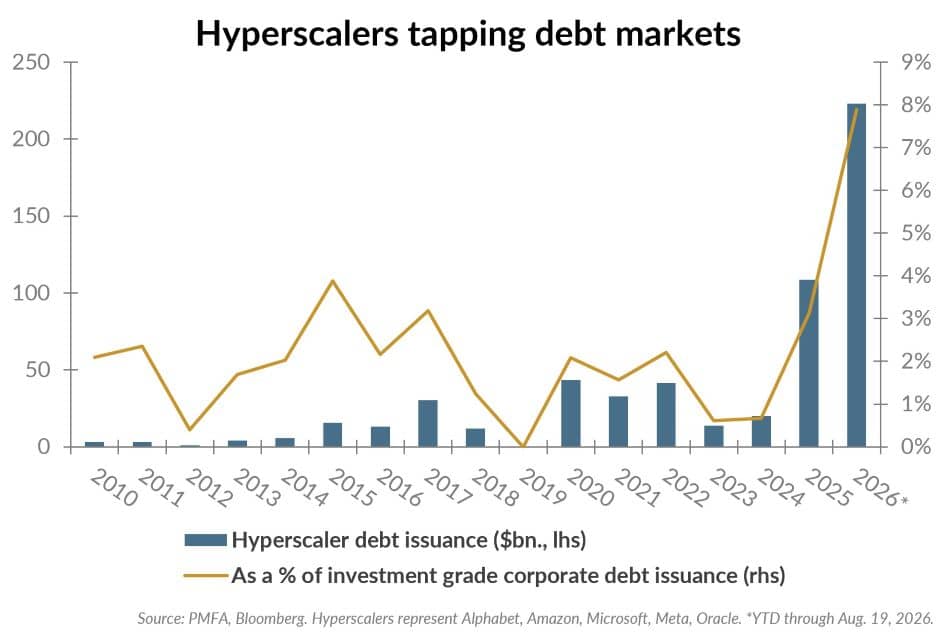
As we discussed in our July 9 commentary, the largest technology companies continue to pursue elevated capital spending in AI infrastructure, data centers, and computing capacity as they jockey for leadership in a rapidly developing market. While these businesses generate substantial free cash flow, many are increasingly turning to debt markets to help finance that investment. That’s a notable departure from their limited borrowing needs that characterized much of the pre-2025 period, as illustrated above. Hyperscaler debt now represents roughly 8% of year-to-date aggregate investment-grade corporate bond issuance, up from less than 4% for most of the prior 15 years.
Hyperscaler issuance remains a small share of the broader fixed income market, but its rapid growth is capturing the attention of bond investors to a greater degree. Credit spreads on some AI-related issuers have modestly widened relative to the broader investment-grade market as investors weigh exceptional business fundamentals against elevated capital spending requirements. Still, the growing reliance on debt financing highlights an important reality: The AI investment cycle is no longer just an equity story. It’s increasingly shaping capital allocation decisions, corporate borrowing trends, and fixed income market dynamics, While far from the primary driver of higher Treasury yields, growing demand for investor capital from hyperscalers is one factor contributing to the broader supply-demand backdrop.
Past performance does not guarantee future results. All investments include risk and have the potential for loss as well as gain.
Data sources for peer group comparisons, returns, and standard statistical data are provided by the sources referenced and are based on data obtained from recognized statistical services or other sources believed to be reliable. However, some or all of the information has not been verified prior to the analysis, and we do not make any representations as to its accuracy or completeness. Any analysis nonfactual in nature constitutes only current opinions, which are subject to change. Benchmarks or indices are included for information purposes only to reflect the current market environment; no index is a directly tradable investment. There may be instances when consultant opinions regarding any fundamental or quantitative analysis may not agree.
Plante Moran Financial Advisors (PMFA) publishes this update to convey general information about market conditions and not for the purpose of providing investment advice. Investment in any of the companies or sectors mentioned herein may not be appropriate for you. You should consult a representative from PMFA for investment advice regarding your own situation.
.jpg?la=en&h=307&mw=480&w=480&hash=B3933C39F4E8A96C36E339BFF108FEA0)

