

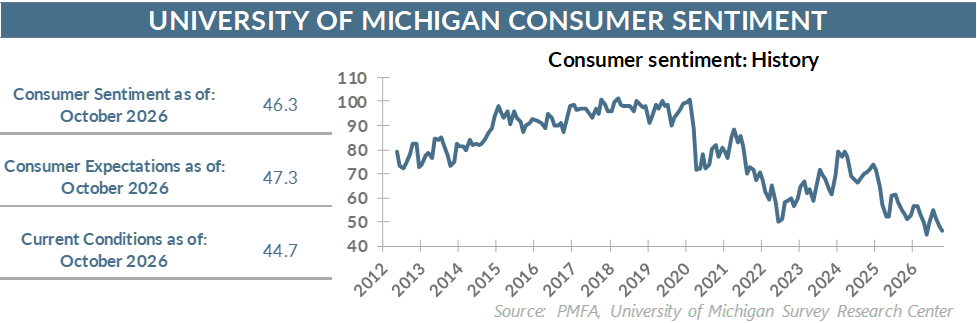
The bottom line? The K-shaped economy is readily apparent in sentiment
- The economy is growing solidly, layoffs remain historically low, and unemployment is constructively rangebound — all supportive of stronger consumption growth in recent quarters.
- Still, consumers are sending a clear message of discontent as already high prices, compounded by continued inflation, strain household budgets.
- The recent surge in interest rates has exacerbated already strained housing affordability and is putting other big-ticket purchases such as vehicles out of reach for more potential buyers.
- As lower-income households effectively tread water, consumption growth is being increasingly fueled by upper-income earners who’ve benefited from strong portfolio gains in recent years. If that dynamic persists, it will make economic momentum vulnerable to the risk of a stock market pullback.
- Boil it all down, and it’s an economy in which the macro data still somewhat masks the experience of a large portion of American households. That bifurcation is readily apparent in sentiment data, which illustrates the divide in a K-shaped economy.
- The economy may be far from recession, but for a meaningful share of American households, it increasingly feels like one.
- The disconnect between macroeconomic data and individual experiences shouldn’t be overlooked. Solid GDP growth and other economic data confirm that the economy continues to expand. Weak sentiment provides greater insight into how unevenly that growth is being felt.
By the numbers: Collective consumer mood remains subdued
- The University of Michigan Consumer Sentiment Index moderated in early October, edging lower to 46.3 in the preliminary survey results for the month. While still modestly above the index’s record low of 44.8 reached last May, sentiment remains depressed by historical standards.
- The index also remains well below its three-year peak of 79.4 reached in March 2024, underscoring a prolonged period of subdued confidence.
- Beneath the surface, the two components of the headline index moved in opposite directions. Consumers are increasingly frustrated with what they’re experiencing — a reality that’s apparent in the sharp decline in the Current Economic Conditions index, which has fallen by nearly 24% over the past year. Sticky, elevated inflation and the recent surge in interest rates were among the greatest challenges noted.
- On a forward-looking basis, the mood improved slightly, while remaining subdued overall. Inflation expectations continue to increase as rising fuel prices further strain household budgets.
Tighter financial conditions and sticky inflation are front and center as election nears
- It may seem surprising that the collective consumer mood is so glum at a time when the macroeconomic data points to an economy that’s expanding at a solid pace and unemployment is so low. All else being equal, one wouldn’t expect sentiment survey results to land in a range typically reflective of a recession.
- If anything, the survey seems to reinforce the bifurcation in the economy between lower- and upper-income households, and between those with considerable financial wealth and those with limited exposure to the stock market.
- In short, it illustrates the challenges in the so-called “K-shaped economy” and the impact of inflation and interest rates that are now at a generational high point.
- Wealthy households, supported by stock market gains, are certainly not immune to inflation, but are better positioned to absorb higher prices and continue to consume, supported by strong stock market appreciation in recent years.
- Contrast that with workers who continue to grapple with inflation concurrent with slowing wage growth as hiring momentum has cooled. For households in which income growth is only growing in line with inflation, there’s a justifiable sense that they’re barely keeping up and certainly not getting ahead.
- It’s also not just elevated inflation in recent years that’s worrying consumers; expected inflation is also ticking higher, suggesting some loss of conviction that the Fed will be successful in slowing the pace of inflation over the next several years.
- Also noteworthy is the fact that the deterioration in sentiment isn’t as concentrated within those self-identifying with either political party as has often been the case in the past. It’s clear that the affordability challenge is being felt and acknowledged across the political spectrum.
- While Americans often view their experience through the lens of political affiliation, that appears to be increasingly not the case. Americans may differ substantially in whom they blame for economic conditions, but affordability pressures now appear to be transcending those traditional political divisions.
- That’s an ominous sign for Republicans heading into the midterm elections in just a few weeks and provides important perspective on polling results that are signaling that they may be poised to lose their House majority. The Senate remains a much closer call.
- “It’s the economy, stupid” was perhaps the defining observation during the 1992 election season, but it increasingly appears to be just as applicable today.
- Consumers across the political spectrum are frustrated with rising prices and a sense of treading water financially. It may not be readily apparent in headline GDP data, but it’s likely to be very apparent as voters cast their ballots in the coming weeks.
Media mention:
Our expert was recently quoted on this topic in the following publication:
Past performance does not guarantee future results. All investments include risk and have the potential for loss as well as gain.
Data sources for peer group comparisons, returns, and standard statistical data are provided by the sources referenced and are based on data obtained from recognized statistical services or other sources believed to be reliable. However, some or all of the information has not been verified prior to the analysis, and we do not make any representations as to its accuracy or completeness. Any analysis nonfactual in nature constitutes only current opinions, which are subject to change. Benchmarks or indices are included for information purposes only to reflect the current market environment; no index is a directly tradable investment. There may be instances when consultant opinions regarding any fundamental or quantitative analysis may not agree.
Plante Moran Financial Advisors (PMFA) publishes this update to convey general information about market conditions and not for the purpose of providing investment advice. Investment in any of the companies or sectors mentioned herein may not be appropriate for you. You should consult a representative from PMFA for investment advice regarding your own situation.


