

The bottom line: The path back to 2% inflation remains long and uneven
- “Are we there yet?” is the question from the back seat that drives parents nuts on long family road trips. Increasingly, it’s the question being asked by frustrated consumers looking for better news on inflation.
- Consumer inflation took another step in the wrong direction in September, coming in hotter than expected, signaling that Fed policymakers still have work to do and strengthening the case for another rate hike in the coming months.
- While attempting to step back from forward guidance, members of the Fed’s inner circle have been sending a clear message to the market that balances the need for further tightening with a tempered, patient approach to doing so.
- Hotter-than-expected September CPI data seems unlikely to increase the Fed’s perceived urgency to hike again later this month, but it will bring December into tighter focus.
By the numbers: Consumer inflation comes in hot for September
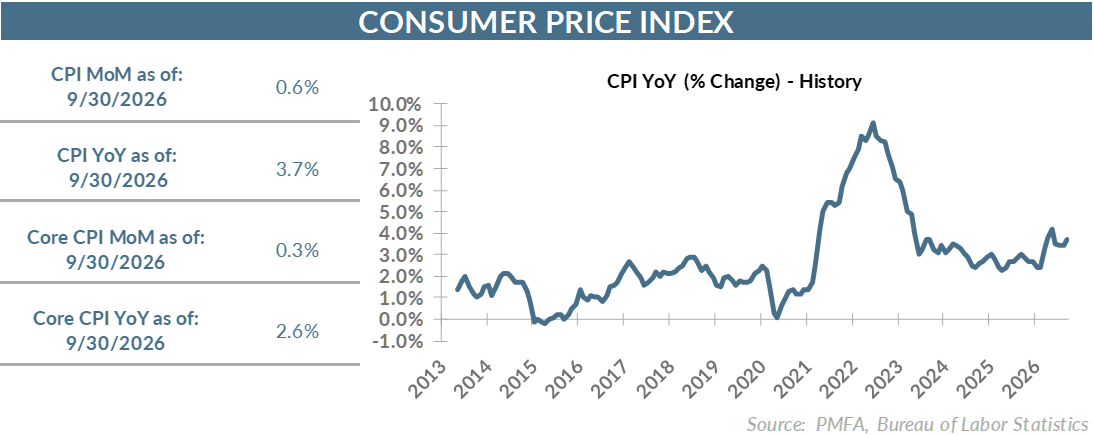
- The consumer price index rose by 0.6% in September, fractionally above expectations.
- Core CPI, which excludes food and energy, edged up by 0.3%, fractionally more than the 0.2% forecast.
- On a year-over-year basis, headline CPI increased by 3.7%, while Core CPI rose by a slightly tamer 2.6%.
Broad thoughts: It’s not just gas prices
- Inflation has come off the boil in recent years, but has been a particularly vexing problem for consumers, businesses, and policymakers alike. The hotter-than-expected September CPI report will renew many questions about what will be necessary for the Fed to tame the inflation beast.
- Surging energy prices are the most immediate challenge, with gasoline prices rising by over 9% last month and nearly 35% over the past year.
- Higher gas prices are a double whammy for consumers; not only are consumers forced to pay more when they fuel up, but they’re reminded of high prices every time they pass a gas station. The increased visibility and inherent volatility of gas prices often weigh more heavily on sentiment than is likely the case for other products and services.
- For Fed policymakers, the impact of energy inflation is diminished because of its volatile nature and the expectation that a ratcheting back of geopolitical tensions could provide relief quickly. Unlike other products and services, gas prices are volatile in both directions, and prices could easily subside with a ratcheting back of tensions globally and a normalization in conditions.
- Even so, higher prices at the pump aren’t the only catalysts keeping inflation well above the Fed’s 2% target. Service sector inflation also remains elevated, rising by 0.4% in September and 3.1% over the past year. The indirect impact of energy inflation is evident in the sharp increase in prices for transportation, where the costs of higher fuel prices are being passed along to the consumer. Still, there’s more to the story.
- In particular, shelter costs continue to rise at a faster pace. One might question whether the calculation methodology masks underlying trends, but there’s no question that housing affordability remains a challenge for potential homebuyers. The recent surge in mortgage interest rates has only exacerbated the challenge, putting a potential purchase a little more out of reach for some potential buyers.
- Inflation and general affordability challenges remain the central economic frustration point for households, weighing heavily on measures of the collective mood.
- Rising prices haven’t caused consumers on the whole to buckle though. At a high level, the divergence between consumer confidence and actual consumer spending suggests that there’s a divide between what they’re saying and what they’re doing.
- Higher prices and elevated inflation are still sources of angst with no immediate end in sight, but consumption remains solid as a key pillar supporting growth.
- The limitation in the macro data is that it doesn’t capture what’s happening under the surface. Consumption is solid, but much of the lift has come from upper-income households that have benefited from the wealth effect of rising home and stock prices in recent years.
- That’s a very different reality for Americans who are living paycheck to paycheck, in which a surge in gasoline prices may mean tough choices about where they can trim spending to live within their means.
- Inflation has been appropriately characterized as a regressive tax, the burden of which falls more heavily on those least able to afford it. It’s a source of frustration for all, but a much bigger problem for those with less flexibility in their finances.
- That’s the biggest challenge for consumers today — one that trumps a strong labor market, historically low layoffs, and solid wage growth.
- The risk of recession still appears relatively low, but for far too many American households, the reality of high — and still rising — prices cast a long shadow that dims their perception of their financial position and their assessment of the overall state of the economy.
Past performance does not guarantee future results. All investments include risk and have the potential for loss as well as gain.
Data sources for peer group comparisons, returns, and standard statistical data are provided by the sources referenced and are based on data obtained from recognized statistical services or other sources believed to be reliable. However, some or all of the information has not been verified prior to the analysis, and we do not make any representations as to its accuracy or completeness. Any analysis nonfactual in nature constitutes only current opinions, which are subject to change. Benchmarks or indices are included for information purposes only to reflect the current market environment; no index is a directly tradable investment. There may be instances when consultant opinions regarding any fundamental or quantitative analysis may not agree.
Plante Moran Financial Advisors (PMFA) publishes this update to convey general information about market conditions and not for the purpose of providing investment advice. Investment in any of the companies or sectors mentioned herein may not be appropriate for you. You should consult a representative from PMFA for investment advice regarding your own situation.


