

The bottom line: Stable claims reinforce a resilient labor market
- Another week of low, stable jobless claims reinforces a familiar story: hiring has cooled, but employers still aren’t inclined to cut workers.
- Slower job creation, fewer openings, and lower turnover are all reflective of a labor economy that’s not as dynamic, but it’s still resilient.
- It’s not a strong environment for those looking for work or role change, but it’s also one in which comparatively few in the workforce should be looking over their shoulder out of concern that a cooling macro outlook puts their job at risk. That distinction is important.
By the numbers: Little evidence of deterioration
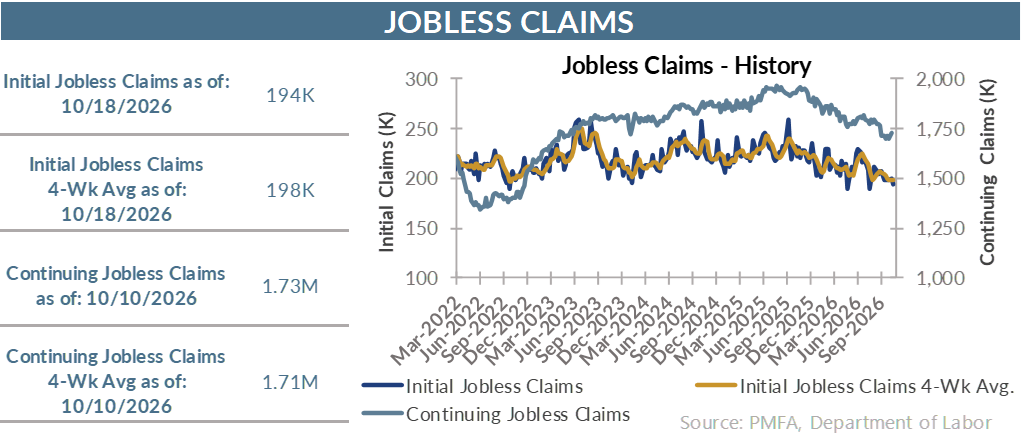
- Initial jobless claims receded to 194,000 for the week ended October 17 — a decline of 6,000 from the preceding week’s revised level of 200,000. Weekly claims have been tightly rangebound in recent months, reflecting remarkable stability in layoffs.
- Weekly claims can often be noisy, but that volatility has been unusually muted of late. There’s simply very little in the claims data to suggest that labor conditions are even modestly deteriorating.
- Slower payroll growth reflects a hiring environment that’s not robust, but one that also needs to be viewed through the lens of labor supply. Labor force growth has slowed considerably, reflecting demographic pressures and a sharp reduction in immigration. Against that backdrop, slower job creation doesn’t necessarily signal material weakness as much as it does the constraints of an aging population and other demographic forces.
What does it mean for the Fed?
- One claims report won’t determine next week’s Fed decision, particularly given the relative steadiness in the data series in recent months. If anything, that continued stability gives policymakers less reason to believe the labor market requires additional support.
- The relative firmness of labor conditions allows the Fed to maintain its primary focus on inflation. A labor market that has cooled without cracking gives policymakers greater latitude to tackle the inflation problem more directly, raising short-term interest rates further to attempt to tighten its grip on price pressures.
- Still, it’s the broader mix of labor and inflation data that matters more than claims alone. Even so, there’s very little in the claims data to suggest a need for the Fed to worry that its efforts to arrest inflation risk the unwanted tradeoff of choking a labor economy that’s already teetering. That just doesn’t appear to be the case.
- Whether the Fed sees sufficient resilience in the labor economy and enough urgency in the recent inflation data to hike again next week remains to be seen. Another rate hike now would be a moderate surprise though, with hints from policymakers and investors broadly looking toward December as the more likely target for another quarter-point hike.
Past performance does not guarantee future results. All investments include risk and have the potential for loss as well as gain
Data sources for peer group comparisons, returns, and standard statistical data are provided by the sources referenced and are based on data obtained from recognized statistical services or other sources believed to be reliable. However, some or all of the information has not been verified prior to the analysis, and we do not make any representations as to its accuracy or completeness. Any analysis nonfactual in nature constitutes only current opinions, which are subject to change. Benchmarks or indices are included for information purposes only to reflect the current market environment; no index is a directly tradable investment. There may be instances when consultant opinions regarding any fundamental or quantitative analysis may not agree.
Plante Moran Financial Advisors (PMFA) publishes this update to convey general information about market conditions and not for the purpose of providing investment advice. Investment in any of the companies or sectors mentioned herein may not be appropriate for you. You should consult a representative from PMFA for investment advice regarding your own situation.


