

First, the bottom line: Headline strength belies the underlying story
- The September retail sales gain was strong, but the underlying composition of that gain reflects a reality that helps explain why the collective consumer mood is sullen.
- The seeming inconsistency between solid consumption and poor sentiment in part reflects the difference between what consumers say and what they do. Overall, they’re not happy, but they’re still spending.
- It also reflects the reality of a K-shaped economy, with an investor class that continues to see their net worth rise as the stock market rises, sustaining wealth-effect driven consumption momentum. It’s that wealth effect that acts as a major driver of consumption growth.
- The average consumer may still be spending, but they’re also treading water as prices rise. There’s much less room for discretionary spending for individuals living paycheck to paycheck.
- Against that backdrop, it’s not surprising that sentiment remains weak. The economy isn’t in recession, but for many lower- and middle-income families, it may feel like it.
By the numbers: Strong headline, softer core
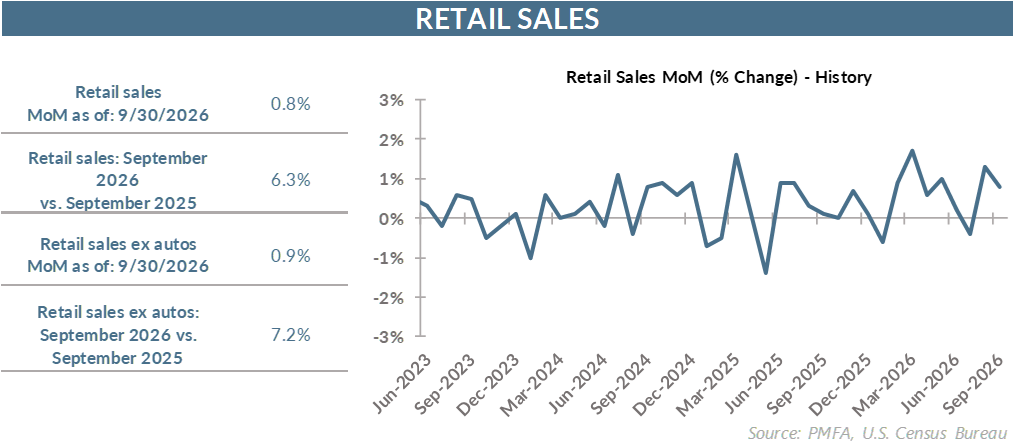
- Retail sales rose by a brisk 0.8% in September, easily topping forecasts for a more pedestrian 0.3% increase.
- Soaring energy costs were the biggest story, with higher gas prices forcing drivers to pay up at the pump. Gas station sales grew by 6.4% to lead all retail sectors.
- Restaurant sales rose by 1.1%, a surprisingly good result suggesting that consumers haven’t resorted to significant belt-tightening to pay more to fill their tanks.
- Despite the jump in gas prices, sales excluding gas stations still rose by 0.2% — a result that looks superficially tepid but is somewhat reassuring. The fact that consumers still found a way to increase spending on other goods even in the face of higher prices at the pump suggests a resilience that bodes well for the near term, particularly if gas prices stabilize or edge lower in the near term.
Squaring solid growth with subdued sentiment
- The strong monthly retail sales gain looks good on paper but requires a skeptical eye. The 0.8% headline gain overstates the underlying strength of consumer demand. Higher gas prices skewed the monthly increase considerably, with sales excluding gas stations rising a much more modest 0.2%.
- It’s also critical to recall that retail sales aren’t adjusted for inflation; adjusting for higher prices, sales growth in real terms looks much more subdued.
- Gas stations may have benefited from a 6.4% jump in sales for the month. That might have been good news for those retailers, but consumers would much rather spend those dollars on virtually anything else, making it little more than a tax against other spending.
- The delivery of three economic data points this morning paints a mixed, but still largely constructive, picture.
- Initial jobless claims remained low for the week ended October 10, coming in a tick below 200,000, effectively reaffirming the “no fire” part of the “no hire, no fire” labor market remains intact.
- Low unemployment and limited layoffs still provide a solid backdrop for consumers and their ability to spend in the face of rising costs.
- On the heels of yesterday’s hotter-than-expected CPI report, September PPI also confirmed that inflation remains a challenge not only for consumers, but businesses as well.
- The 1.3% single-month increase in PPI for final demand lifted the 12-month trailing PPI to 6.3% — its highest point since December 2022. Soaring wholesale gas prices played a major role, accounting for about half the total increase.
- Pulling the disparate data together, the underlying narrative is a mixed one that helps square the seeming disconnect between consumer spending and sentiment. Solid labor conditions and wage gains are continuing to backstop consumption, despite the persistence of elevated inflation that limits discretionary spending for many households.
- The fact that the consumer sector can absorb an upward shock in gas prices and still finds a way to increase spending even modestly speaks to consumer resilience, although that isn’t likely to be open-ended.
- Consumers may have gritted their teeth and looked through higher gas prices to a point, hoping for some near-term easing. The longer that fuel prices remain elevated, the greater the probability that consumers will need to curtail discretionary spending.
- For retailers, the growing risk is that consumers start to rein in spending as retailers head into the critically important holiday sales season.
- A broader view of economic data reinforces the argument that the economy is K-shaped, with the divide between lower and lower-middle income households and upper-income households widening.
- The strength of the stock market has underpinned confidence for affluent households, who are bothered by inflation, but remain comparatively well positioned to spend with confidence.
- That stands in sharp contrast with lower-income consumers who’ve felt the full effect of the regressive tax of inflation to a much more significant degree and are more likely to have to cut discretionary spending to absorb the rapid rise in prices for fuel, food, and shelter.
- To this point in the cycle, consumption has been sustained despite consumers’ deep-seated frustration with inflation and a persistently negative assessment of the economy that is readily apparent in sentiment surveys.
- That’s the reality of a K-shaped economy that can be obscured by the macro data. The economy remains on solid footing overall, but the benefits of growth aren’t being experienced equally, nor is the burden of inflation.
Media mention:
Our expert was recently quoted on this topic in the following publication:
Past performance does not guarantee future results. All investments include risk and have the potential for loss as well as gain.
Data sources for peer group comparisons, returns, and standard statistical data are provided by the sources referenced and are based on data obtained from recognized statistical services or other sources believed to be reliable. However, some or all of the information has not been verified prior to the analysis, and we do not make any representations as to its accuracy or completeness. Any analysis nonfactual in nature constitutes only current opinions, which are subject to change. Benchmarks or indices are included for information purposes only to reflect the current market environment; no index is a directly tradable investment. There may be instances when consultant opinions regarding any fundamental or quantitative analysis may not agree.
Plante Moran Financial Advisors (PMFA) publishes this update to convey general information about market conditions and not for the purpose of providing investment advice. Investment in any of the companies or sectors mentioned herein may not be appropriate for you. You should consult a representative from PMFA for investment advice regarding your own situation.


