

First, the bottom line: Consumers aren’t happy, but they’re still spending
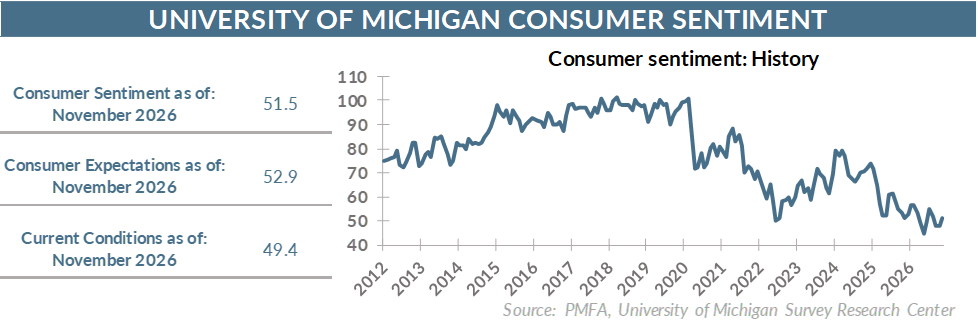
- Consumer sentiment improved in November, but the broader story hasn’t meaningfully changed. Consumers remain deeply frustrated by the cumulative impact of inflation in recent years even as their spending continues to provide a solid foundation under economic growth.
- The disconnect between what consumers say and what they do remains striking. Sentiment is exceptionally weak — still near levels typically reserved for periods of recession. In contrast, the hard data tell a considerably more constructive story. Economic growth remains strong, the labor market is on solid footing, and consumers continue to spend, albeit begrudgingly.
- Years of elevated inflation have lifted prices significantly across virtually every major household spending category. Inflation may have come off the boil, but higher prices are here to stay. That’s a reality that consumers are still coming to grips with.
- For now, a solid labor economy, rising incomes and household wealth continue to provide consumers with the capacity to spend, even if they don’t feel particularly upbeat in their assessment of the economy.
By the numbers: Sentiment improves, but remains subdued
- The University of Michigan Consumer Sentiment Index rose about 7% in November to 51.5 from 48.0 in October but remains 9% below its February level.
- The increase was led by improvement in expectations. The Consumer Expectations Index jumped to 52.9 from 48.8, while the Current Economic Conditions Index also rose, but more modestly to 49.4 from 46.7.
- Underpinning that improvement was a notable decline in inflation expectations — a key contributor to consumer worries. One-year inflation expectations fell sharply to 3.7 from 4.7%, while longer-term expectations eased to 3.3 from 3.5%. Falling gasoline prices, which were a major catalyst for inflation expectations on the way up, appear to be a key source of relief in the past month.
- That’s an encouraging development, but consumers continue to identify inflation rather than potential job loss as the greater threat to their financial well-being. For most consumers, labor market stability has kept worries about potential job loss at bay, providing the confidence and fuel to continue spending, despite affordability challenges.
- Boil it all down, and the story behind the sentiment story is clear. Jobs aren’t the primary problem. Affordability is.
Context and implications: What consumers say and what they do remain two different things
- The hard and soft data aren’t necessarily telling contradictory stories. Consumers remain unhappy about what things cost, but employment, rising incomes and household wealth continue to provide the capacity to spend.
- That’s particularly important given the strength that’s evident in the hard data. Consumer spending remains resilient, economic growth has been strong and labor market conditions remain broadly supportive. October’s retail results also reinforced that strength, with auto sales being a notable exception.
- The one-two punch of rising prices and higher interest rates is most evident in housing and auto sales, both of which are heavily dependent on consumer borrowing. Both have continued to soften as interest rates have risen. More broadly though, consumers have otherwise seemingly been willing and able to spend.
- Household wealth has also provided an important tailwind, particularly for higher-income consumers who have benefited disproportionately from the strong stock market returns and rising home prices in recent years. That’s been important given the outsized contribution of higher-income consumers to overall consumption.
- The wealth effect also points to the potential vulnerability of continued consumption growth to a pronounced, prolonged market correction. Balance-sheet growth supports spending during positive market environments but can quickly become a headwind when asset prices fall.
- Consumers may not feel particularly good about the economy, but they’re still spending in a manner that reflects solid growth. Further easing in inflation pressures would go a long way toward narrowing that disconnect between what consumers are saying and what they’re doing. In the meantime, as long as employment, income growth and household balance sheets remain supportive, that disconnect can persist.
Past performance does not guarantee future results. All investments include risk and have the potential for loss as well as gain
Data sources for peer group comparisons, returns, and standard statistical data are provided by the sources referenced and are based on data obtained from recognized statistical services or other sources believed to be reliable. However, some or all of the information has not been verified prior to the analysis, and we do not make any representations as to its accuracy or completeness. Any analysis nonfactual in nature constitutes only current opinions, which are subject to change. Benchmarks or indices are included for information purposes only to reflect the current market environment; no index is a directly tradable investment. There may be instances when consultant opinions regarding any fundamental or quantitative analysis may not agree.
Plante Moran Financial Advisors (PMFA) publishes this update to convey general information about market conditions and not for the purpose of providing investment advice. Investment in any of the companies or sectors mentioned herein may not be appropriate for you. You should consult a representative from PMFA for investment advice regarding your own situation.


