

First, the bottom line: The economy has more momentum than previously recognized
- The economy isn’t merely hanging in there. It continues to demonstrate considerable resilience, with consumers spending, businesses investing, and few signs that restrictive monetary policy is creating significant cracks in the broader expansion.
- Perhaps more importantly, strength is largely coming from the right places. Consumers and business investment remain the two primary pillars under growth, suggesting that underlying private sector demand remains quite healthy.
- The ongoing AI investment boom is an important part of that story. The scale of investment in technology, data centers, and the infrastructure needed to support them is providing a meaningful tailwind for the economy today, while the hoped-for productivity benefits still lie largely ahead.
- At this point, it’s not just an AI build-out story; a notable resurgence in consumer spending this year has provided a second critical source of strength underpinning the expansion. The combination of robust business investment and household spending pushed growth even further into positive territory in the third quarter — much closer to an economy that looks like it’s closer to being at risk of overheating than one that was on the verge of tipping toward recession.
- Boil it all down, and today’s report reinforces an increasingly familiar tension: the economy is performing quite well, but its resilience also gives the Fed an even stronger case for further rate hikes. It’s good news for the economic outlook, but potentially less welcome for borrowers hoping that softer growth will pave the way for lower rates.
By the numbers: Consumers spend and businesses invest at a solid clip
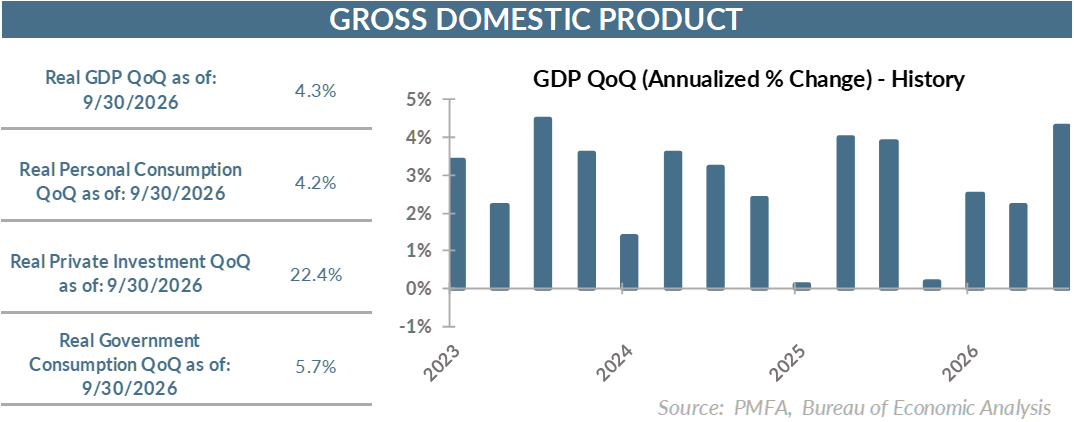
- Real GDP grew at a 4.3% annualized pace in the third quarter, accelerating sharply from 2.2% in Q2 and revised up from the initial estimate of 3.4%. The upward revision primarily reflected stronger investment and consumer spending.
- Beneath the headline, real final sales to private domestic purchasers surged 5.8%, an especially notable indication of the strength of underlying private sector demand.
- Real consumer spending increased by 4.2%, with broad-based strength across both goods and services. Real spending on goods rose 4.7%, including gains of 6.3% in durable goods and 4.5% in nondurable goods, while real spending on services increased 4.2%.
- Gross private domestic investment surged 22.4%, led by strong fixed investment. The BEA also indicated that the upward revision to investment was led by intellectual property products, notably software. Investment in technology has been growing at a rapid clip in recent years, and — at least for now — shows little sign of falling off.
- Housing remained a notable weak spot, with residential investment declining 3.4%.
- Government spending increased 5.7%, driven primarily by stronger federal spending, while state and local spending was comparatively tepid.
- The income side of the ledger provided further confirmation of the broader growth story. Real gross domestic income increased 4.4%, while corporate profits from current production rose by $206 billion.
What it means: Strong momentum complicates the case for lower rates
- The consumer remains a key pillar under the expansion. Households may not feel particularly upbeat, but they continue to spend. Importantly, the strength was broad in Q3, with solid real growth in both goods and services. More recently, a sharp decline in gas prices flowed through to some improvement in measures of the consumer mood and inflation expectations. Still, sentiment remains restrained, particularly given the strength of the labor economy and the crisp pace of consumption growth.
- Business investment provides the second pillar holding up growth. The AI-related capital-spending boom is adding meaningfully to demand today, while the hoped-for productivity payoff lies principally in the future. Over time, stronger productivity could allow the economy to sustain growth while introducing an important disinflationary catalyst that could help to rein in persistently elevated inflation. That’s not a near-term benefit, but one that has the potential to be meaningful as the adoption of various AI-related tools creates efficiencies in the future.
- That doesn’t mean every part of the economy is equally strong. Standing in sharp contrast to solid consumer spending growth, the housing affordability challenge remains a high hurdle for potential buyers. The brisk increase in home prices since 2020 and surging mortgage rates in recent years have put purchases further out of reach for many first-time buyers, while reducing the attractiveness of scaling up for many others. The result is a frigid backdrop for housing activity.
- For capital markets, strong growth and rising corporate profits provide a constructive backdrop for revenues and earnings. Higher interest rates will ultimately bear fruit for fixed income investors, although the drag of rising rates has weighed on bond performance this year. Rising interest rates have also chilled equity markets to a point, with P/E multiples feeling the weight of higher yields. That’s been less obvious perhaps, as the strength of earnings growth has, until recently, been sufficiently positive to fuel investor enthusiasm. That’s changed in recent weeks as a host of other worries have entered the equation, causing investors to take a step back and reassess.
- That brings the story back to the Fed. The economy simply isn’t sending a clear signal that it needs additional monetary policy support. If anything, it’s making the case that the Fed should do more to pull in the reins on growth and inflation. Increasingly, the labor market appears to be on a sufficiently strong footing to withstand higher rates. Growth is strong, underlying private demand is even stronger and inflation remains above target. Unless inflation continues to move convincingly in the right direction, there’s little in today’s report arguing for the Fed to take its foot off the brake.
Media mentions:
Our expert was recently quoted on this topic in the following publications:
Past performance does not guarantee future results. All investments include risk and have the potential for loss as well as gain.
Data sources for peer group comparisons, returns, and standard statistical data are provided by the sources referenced and are based on data obtained from recognized statistical services or other sources believed to be reliable. However, some or all of the information has not been verified prior to the analysis, and we do not make any representations as to its accuracy or completeness. Any analysis nonfactual in nature constitutes only current opinions, which are subject to change. Benchmarks or indices are included for information purposes only to reflect the current market environment; no index is a directly tradable investment. There may be instances when consultant opinions regarding any fundamental or quantitative analysis may not agree.
Plante Moran Financial Advisors (PMFA) publishes this update to convey general information about market conditions and not for the purpose of providing investment advice. Investment in any of the companies or sectors mentioned herein may not be appropriate for you. You should consult a representative from PMFA for investment advice regarding your own situation.


