

The bottom line: March oil price surge swamps
- It’s not that the February CPI report was bad that matters; it’s that the surge in oil prices and its ripple effects over the past 10 days matter more — much more — to the inflation outlook.
- While good news, the amount of print that will be given to the February CPI report will be understandably limited, as the report doesn’t reflect the spike in oil prices over the last two weeks. That’s the story right now, and easily the biggest risk to the near-term inflation outlook and global economy.
- Oil prices have been extremely volatile in recent days, as the conflict spreads in and around Iran, leading to an effective closure of the Strait of Hormuz. If recent reports are true that Iran has now laid mines within the Strait, the stakes have been raised even further.
- Consumers are already seeing the impact when they fill their gas tanks; the question is how much more could prices rise and how long could the crisis last. In the meantime, the negative impact on sentiment and higher energy prices are likely to cause consumers to tighten up spending in other areas.
By the numbers: February inflation was decent, but attention has already turned to March
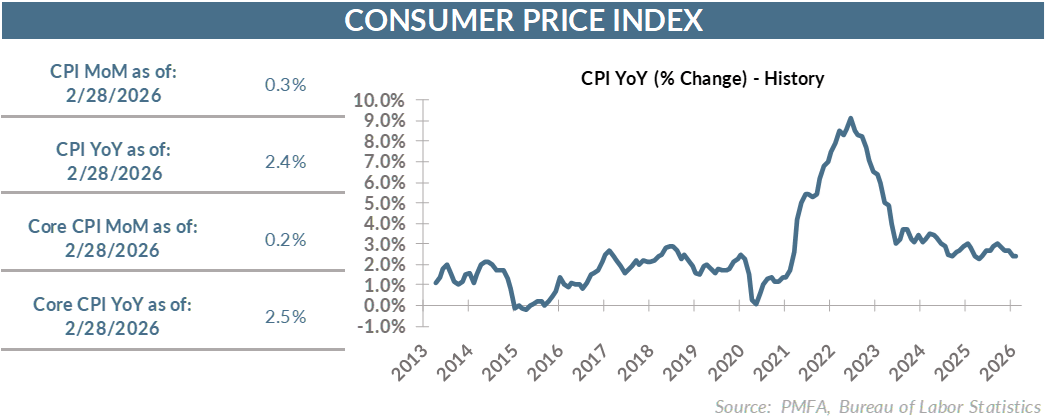
- The consumer price index was unchanged at 2.4% in February; the 0.3% gain for the month was in line with the consensus forecast.
- Core CPI, which excludes food and energy, edged up by 0.2%, also in line with expectations heading into its release. At 2.5%, core inflation continues to run slightly higher than the headline measure, ironically held in check by energy prices over the past year.
- That dynamic is poised to change in a meaningful way, as the significant escalation of hostilities in the Middle East has pushed oil prices sharply higher.
- On a brighter note, the report provided one key disinflationary indicator. Shelter inflation — significant for its considerable weighting within the index — has been a key factor that’s kept inflation running well above the Fed’s 2% target in recent years. Its 0.2% increase in February matched the January gain — a welcome signal that price pressures in housing continue to recede.
Broad thoughts: Fed in an increasingly tight spot
- Much of the focus in recent months has been on the delicate balance between soft labor conditions and still-heightened inflation, and the inherent conflict that presents to the Fed.
- The prevailing view had been that the Fed would likely stand pat after its three insurance cuts, as there were some indications that labor conditions could be stabilizing and inflation, while still above 2%, was slowly receding toward the Fed’s target.
- Market-based expectations for the Fed haven’t changed in the near term, with a nearly zero probability of a rate cut next week being priced into the futures market.
- Nearly no one is expecting the Fed to ease, but there’s also nearly universal recognition that the Fed’s job has gotten harder.
- Tariff uncertainty still hangs over the macro picture, exacerbated by indications that economic momentum continues to slow. The Q4 GDP report was much softer than anticipated and, although still subject to revision, puts the soft labor environment in better context.
- Weaker hiring isn’t simply a byproduct of a lack of labor supply; hiring demand is also slowing. Job openings continue to decline, and job creation has been tepid at best since last summer. Changes in nonfarm payrolls have been unusually choppy month to month but suggest that net hiring has ground to a near halt. Since the announcement of tariffs last April, job creation has averaged a mere 8,000 per month. Over the last three months, the pace has been even softer.
- By GDP or job creation measures, the loss of economic momentum is a warning — and one that Fed policymakers must balance with the risk that already-elevated inflation may be poised to head higher. The key will be how long that the current conflict lasts and how quickly the flow of oil from the Persian Gulf can be largely resumed. In the meantime, global policymakers will have to lean on other means of trying to contain oil prices.
- The IEA’s recommendation for a 400-million-barrel release from global strategic reserves has provided some relief, but oil prices are expected to remain significantly higher than their range prior to the recent escalation in hostilities.
- For the Fed, the threat of higher inflation tightens their policy path and increases the potential for a misstep. Wait too long to raise rates and another feared inflation surge could become reality. Reverse their recent easing course to address higher prices and risk further exacerbating already weak hiring conditions. The conflicting forces create a tighter path for the Fed to walk as it attempts to navigate the economy forward constructively.
- All of this comes as a leadership transition at the Fed is within sight, raising further questions about the potential for a shift in policy tone and a new Fed chair that won’t have the luxury of easing into the job against sanguine macro backdrop.
Media mentions:
Our experts were recently quoted on this topic in the following publications:
Past performance does not guarantee future results. All investments include risk and have the potential for loss as well as gain.
Data sources for peer group comparisons, returns, and standard statistical data are provided by the sources referenced and are based on data obtained from recognized statistical services or other sources believed to be reliable. However, some or all of the information has not been verified prior to the analysis, and we do not make any representations as to its accuracy or completeness. Any analysis nonfactual in nature constitutes only current opinions, which are subject to change. Benchmarks or indices are included for information purposes only to reflect the current market environment; no index is a directly tradable investment. There may be instances when consultant opinions regarding any fundamental or quantitative analysis may not agree.
Plante Moran Financial Advisors (PMFA) publishes this update to convey general information about market conditions and not for the purpose of providing investment advice. Investment in any of the companies or sectors mentioned herein may not be appropriate for you. You should consult a representative from PMFA for investment advice regarding your own situation.


