

First, the bottom line: Evidence of stability, healing
- The April employment report suggests the economy may be moving past the choppy, sawtooth pattern that defined job creation over much of the past year.
- Two months may not make a trend but provides some rationale for nascent optimism that the labor market may be regaining its footing.
- The fact that hiring has been solidly above 100,000 in each of the past two months is particularly encouraging given the shrinking supply of workers.
- Job creation doesn’t need to be high for labor conditions to be tight and for unemployment to remain in a constructive range. Given the long-term graying of the U.S. population and a marked slowdown in immigration, the pace of job creation in the past two months is even more encouraging.
By the numbers: Better job creation, shrinking labor force
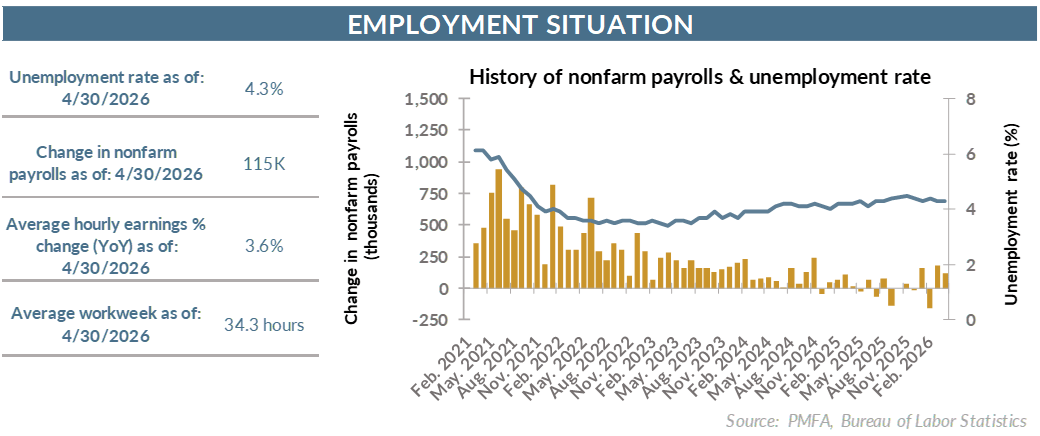
- Nonfarm payrolls increased by 115,000 in April, a result that was well above expectations coming into the report, with the consensus forecast looking for a gain of 67,000–85,000.
- Revisions to the prior two months shaved 16,000 off the aggregate increase. The three-month average monthly increase of 48,000 still looks tepid on paper but was weighed down by the weak February results. Conversely, the average gain of 150,000 over the past two months suggests a meaningful bounce back in hiring momentum.
- Job creation in April was heavily concentrated in the service sector, with healthcare workers again accounting for a disproportionately high portion of the total gain. Nonetheless, gains in construction, transportation and warehousing, and retail also contributed meaningfully to the increase. Manufacturing employment took a step back.
- The unemployment rate was unchanged at 4.3%, reflective of some welcome stabilization in labor conditions.
- Wage growth edged up by 0.2% in April, which was slightly less than expected, with the trailing 12-month gain only fractionally changed at 3.6%.
Broad thoughts: Labor supply challenges may be alleviated by the arrival of AI tools
- Underlying an otherwise positive report is further evidence of a significant demographic headwind to job creation. The labor force continues to shrink, owing to a sharp slowdown in the pace of immigration in the past year and the long-term aging of the U.S. population. Labor force participation edged down to 61.8% in April, the latest stairstep lower as Americans slowly but persistently leave the labor force.
- While subject to revision, the data suggests that the pool of workers shrank by over one million individuals in the past year, even as the estimated civilian noninstitutional population grew by nearly 1.8 million.
- Shrinkage in the supply of labor can exacerbate hiring challenges but also helped to keep a lid on rising unemployment against a backdrop of lackluster job creation over the past year.
- A sharp reversal in immigration policy certainly had an impact, but demographic trends and the graying of America also play a meaningful role — and one that won’t be easily reversed.
- There are also practical implications that flow from these headwinds to labor supply.
- First, the scarcity of available workers during the post-pandemic boom in job creation undoubtedly continues to factor into employers’ decision-making. The hiring appetite has slowed considerably, but there’s still little evidence that a tipping point has been reached on layoffs. Employers still appear content to weather periodic weakness in the outlook without trimming payrolls.
- Initial jobless claims remain very low — evidence that a widespread tilt toward workforce reduction simply hasn’t developed.
- A scarcity of available workers also intensifies the importance of productivity gains to increase output. From that perspective, the introduction and implementation of a plethora of AI-based tools could come at a very important time.
- AI-based solutions will be disruptive to many businesses and change the way that workers across a range of industries do their job. For some employers, the adoption of AI-based solutions may result in job losses. For growth-oriented businesses, the implementation of AI tools will change the leverage model, allowing their existing workforce to operate more efficiently and meet growing demand while alleviating the pressure to try to find workers in an environment in which the pool of available workers may be shrinking.
For the Fed: More data pushing back against a rate cut
- Spiking energy prices have reinforced the risk of a resurgence in inflation, challenging the Fed’s predisposition to ease rates further.
- Lackluster hiring had been a key argument made for cuts late last year to ensure against a more pronounced deterioration in labor market conditions and the risk of a more pronounced and prolonged slowdown in growth.
- At the same time, recent measures of inflation and indications of near-term inflation expectations have risen sharply and are poised to edge up further in the near term.
- The impending change in leadership within the Fed adds a wrinkle of uncertainty, but the Fed’s not likely to materially change its tune, absent a meaningful change in the current macro backdrop.
- With two successive months of solid job creation, limited layoffs, and low unemployment, the case for a more supportive rate policy to boost the labor economy has diminished.
Past performance does not guarantee future results. All investments include risk and have the potential for loss as well as gain.
Data sources for peer group comparisons, returns, and standard statistical data are provided by the sources referenced and are based on data obtained from recognized statistical services or other sources believed to be reliable. However, some or all of the information has not been verified prior to the analysis, and we do not make any representations as to its accuracy or completeness. Any analysis nonfactual in nature constitutes only current opinions, which are subject to change. Benchmarks or indices are included for information purposes only to reflect the current market environment; no index is a directly tradable investment. There may be instances when consultant opinions regarding any fundamental or quantitative analysis may not agree.
Plante Moran Financial Advisors (PMFA) publishes this update to convey general information about market conditions and not for the purpose of providing investment advice. Investment in any of the companies or sectors mentioned herein may not be appropriate for you. You should consult a representative from PMFA for investment advice regarding your own situation.


