

First, the bottom line: It could’ve been worse
- After an unusually long wait, the hope was that the November jobs report would provide reassurance that job creation momentum had been sustained during the government shutdown data blackout and that labor conditions had weakened further.
- What the Bureau of Labor Statistics delivered today was at best a mixed review of a labor economy that has neither fallen off a cliff nor regained momentum — a middle ground, but one that’s still quite far from a “not too hot, not too cold” goldilocks outcome.
- The real question is how long the labor economy can persist in a steady state of low payroll growth. “No hire, no fire” can work for a time, but its days are numbered. Either continued growth will ultimately force employers to accelerate hiring or weak labor conditions will bleed into consumption, weighing on spending and contributing to a loss of growth momentum. In that regard, today’s report offered little clarity, leaving plenty of unanswered questions about what lies ahead for the labor economy.
By the numbers: A mixed bag, skewed by federal government buyouts
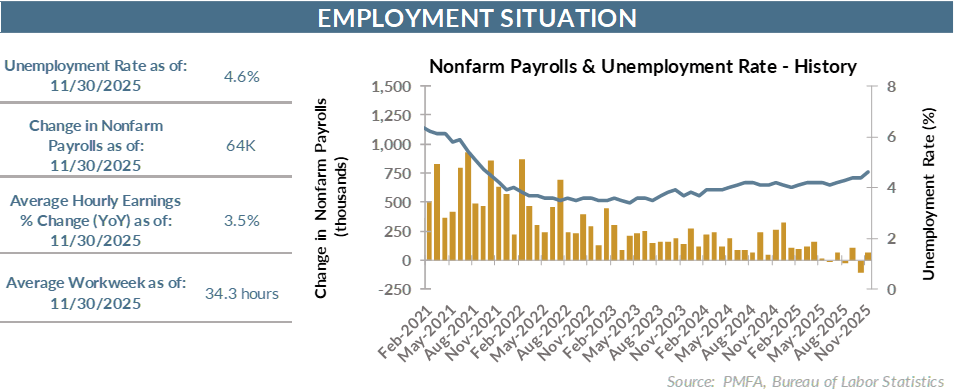
- The unemployment rate rose in November to 4.6% — a new high-water mark for joblessness since September 2021 when hiring was brisk and the post-COVID-19 economy was roaring back.
- Nonfarm payrolls increased by 69,000 in November — moderately better than the consensus forecast for a gain of 50,000, but well below the revised 108,000 gain from the September report.
- Sandwiched between the September and November monthly gains was an outsized October loss of 105,000 jobs tucked into the report. That decline was skewed considerably by the elimination of 162,000 federal government jobs from buyouts earlier this year that paid workers through the September 30 fiscal year-end, delaying their elimination from the workforce until now. Private sector payrolls rose by 52,000 for the month.
- Today’s two-month data dump isn’t an aberration in an otherwise rosy labor picture. The tide turned notably on the heels of the so-called “Liberation Day” tariff announcement in April. Since then, the pace of net hiring has saw-toothed between positive and negative monthly results. Over the past seven months, nonfarm payrolls have increased by less than 20,000 per month on average. By virtually any reasonable expectation, that’s consistent with a disappointing hiring environment and soft labor conditions.
- November wage growth was mediocre, edging up by just 0.1%, while the trailing 12-month gain receded to 3.5%. That marks the slowest wage growth in several years but is still above the high point for the post-GFC decade.
Broad thoughts
- The soft labor market has been frequently characterized as a “no hire, no fire” environment. Since April, a smoothed look at job creation has been lackluster at best. Moreover, the choppiness in the monthly data has kept forecasters alert for any sign of a more sustained deterioration in conditions that could remove the “no fire” floor under payrolls.
- The negative October payrolls print came as no surprise, a meaningful reduction in the federal workforce has been baked in for months. A likely stabilization in federal government payrolls, coupled with the fact that private sector payrolls held up as well as they did, helps to mitigate the impact of the otherwise negative monthly print. Even so, these aren’t victory lap type numbers and the broader concerns around sustained weakness in job creation justifiably raise concerns about how long this “curious balance” can be maintained.
- Further, it’s not just the lackluster pace of job creation that remains a source of caution, but its concentration within just a few sectors of the economy. Take away hiring in healthcare and social assistance, and job creation is at a virtual standstill. Manufacturing employment is stagnating, as are large swaths of the service sector.
- The lack of hiring breadth is a very concerning sign for those looking for work across most sectors and a red flag that the economy isn’t broadly hitting on all cylinders.
- Further weakness in the jobs data will challenge a Federal Reserve that’s recently delivered a string of quarter-point cuts while attempting to reign in expectations about how much additional easing may be in the pipeline. Updated projections delivered by the FOMC last week suggested a baseline of one additional cut next year, but that was predicated on their expectation that on a year-on-year basis, growth would accelerate, inflation would recede, and unemployment would edge down in 2026.
- Investors have taken a more skeptical stance, pricing in multiple cuts in 2026; the November jobs report has only reinforced those views.
- While the Fed will work hard to maintain both the appearance and reality of independence from political pressure, the drumbeat of demands for further rate cuts from the White House will only intensify if unemployment continues to rise or growth falters. Given the soft November jobs report, monetary policymakers may have little choice but to concede and cut further.
Media Mentions:
Our experts were recently quoted on this topic in the following publications:
Past performance does not guarantee future results. All investments include risk and have the potential for loss as well as gain.
Data sources for peer group comparisons, returns, and standard statistical data are provided by the sources referenced and are based on data obtained from recognized statistical services or other sources believed to be reliable. However, some or all of the information has not been verified prior to the analysis, and we do not make any representations as to its accuracy or completeness. Any analysis nonfactual in nature constitutes only current opinions, which are subject to change. Benchmarks or indices are included for information purposes only to reflect the current market environment; no index is a directly tradable investment. There may be instances when consultant opinions regarding any fundamental or quantitative analysis may not agree.
Plante Moran Financial Advisors (PMFA) publishes this update to convey general information about market conditions and not for the purpose of providing investment advice. Investment in any of the companies or sectors mentioned herein may not be appropriate for you. You should consult a representative from PMFA for investment advice regarding your own situation.
.jpg?la=en&h=307&mw=480&w=480&hash=B3933C39F4E8A96C36E339BFF108FEA0)

