


The bottom line: “Good enough”
- Broadly speaking, the December inflation report was more reassuring than concerning, despite a surge in food costs and a stubborn stickiness to price increases that continue to vex Fed policymakers and delay a return to their 2% inflation target.
- Consumer inflation at 2.7% isn’t ideal, but for policymakers and investors, it’s “good enough,” at least for the time being for the Fed to maintain a bias toward trimming.
- That provides little reassurance for many consumers, for whom the frustration caused by rising prices is still real. Inflation may be stabilizing, but higher prices aren’t going away. For lower-income households in particular, the cumulative impact surging prices going back to the height of the COVID-19 pandemic and the period that followed continues to force uncomfortable belt tightening with limited room for discretionary spending.
By the numbers: Food prices surge; December CPI hits the mark
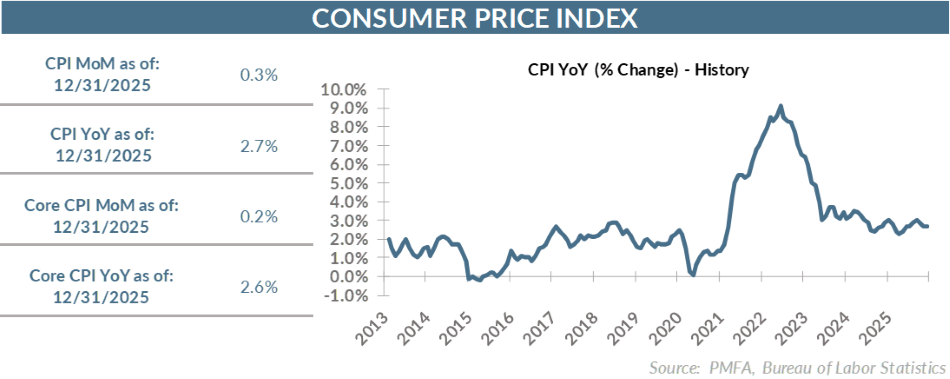
- The consumer price index rose 0.3% in December, in line with the consensus forecast. Core CPI, which excludes food and energy, edged up by 0.2%, fractionally better than the 0.3% forecast.
- On a year-over-year basis, headline CPI increased by 2.7%, while core CPI rose by a slightly tamer 2.6%. Both remain elevated, but relatively stable. That’s the good news.
- Pockets of concern still exist though. Food prices surged at a brisk 0.7% pace, signaling that for many consumers, one of the primary inflation pressure points in recent years is still a challenge. As a larger part of monthly spending for lower-income households, rising food costs remains a reality.
- Shelter costs rose by 0.4% in December and 3.2% over the year.
Broad thoughts: Services, not tariffs, remain the bigger challenge
- Inflation may remain moderately above the Fed’s 2% target, but despite all the worries that the imposition of significant tariffs last year, there’s little evidence that the levies assessed against various imported products are the primary challenge behind still elevated consumer inflation.
- Durable goods prices, which include bigger-ticket items, including home appliances, rose by just 1.2% over the past year, while apparel prices edged up by just 0.6%. Nondurable goods, excluding food and apparel, saw prices increase at a tepid 0.4%. Imported goods represent a large portion of those categories.
- Food prices are perhaps the most notable outlier, although tariffs are only one factor behind rising costs. A more challenging labor outlook in the United States has increased wages for agricultural workers and supply disruptions from disease, weather conditions, and the war in Ukraine have raised food prices globally. Tariffs haven’t helped, but it’s also far from the sole source of price pressure.
- More notable in the inflation picture is the continuing upward pressure in service-related prices, which represents nearly two-thirds of the consumer price index.
- With some signs of moderation, shelter inflation has declined but continues to advance at a pace exceeding the broad index, rising 3.2% over the past year. Shelter inflation is expected to ease further as other data indicates that single-family home prices and residential rental costs are stabilizing. That bodes well for the overall inflation outlook given its significant representation within the index.
- More broadly, the service sector remains beholden to labor conditions, where wages continue to rise at a solid clip. The “no hire, no fire” environment is making it more difficult for unemployed workers to find jobs, but there’s little sign of employers trimming their payrolls meaningfully either. Wage growth was solid in 2025, coming in at 3.8% despite demonstrably weaker labor conditions. Wage pressures remain a primary source of cost increases within the service industry, a reality that continues to be passed through to consumers.
- That leaves the Fed in a good, but not great, position as policymakers attempt to navigate their dual mandate of full employment within the context of price stability.
- In recent months, policymakers have turned their attention toward providing support to labor conditions, trimming their benchmark policy rate by 0.75%. That’s raised concerns in some quarters about the potential that easier policy, along with the flow-through effect of tariffs, could create a second inflationary wave.
- Thus far, those fears have proven to be unfounded; inflation is still elevated but is showing no signs of breaking out to the upside. That bodes well for the Fed’s ability to hold the line on rates if not trim further to support labor conditions.
The bottom line: The December inflation report didn’t deliver a goldilocks reading, which isn’t bad — certainly “good enough” for investors and likely sufficient for Fed policymakers looking for affirmation that their rate cut pivot wasn’t ill-timed, perhaps helping to clear the path for further easing in the months ahead.
Media Mention:
Our experts were recently quoted on this topic in the following publication:
Past performance does not guarantee future results. All investments include risk and have the potential for loss as well as gain.
Data sources for peer group comparisons, returns, and standard statistical data are provided by the sources referenced and are based on data obtained from recognized statistical services or other sources believed to be reliable. However, some or all of the information has not been verified prior to the analysis, and we do not make any representations as to its accuracy or completeness. Any analysis nonfactual in nature constitutes only current opinions, which are subject to change. Benchmarks or indices are included for information purposes only to reflect the current market environment; no index is a directly tradable investment. There may be instances when consultant opinions regarding any fundamental or quantitative analysis may not agree.
Plante Moran Financial Advisors (PMFA) publishes this update to convey general information about market conditions and not for the purpose of providing investment advice. Investment in any of the companies or sectors mentioned herein may not be appropriate for you. You should consult a representative from PMFA for investment advice regarding your own situation.


