


First, the bottom line: A muddy picture of the labor economy
- All in all, the report paints a mixed picture on the state of the labor economy. Hiring is weak, but wage gains are solid. The decline in an already low unemployment rate suggests that labor market slack is limited, but it’s still a challenging environment for those looking for work to successfully find it.
- The data helps to explain why the Fed has trimmed interest rates three times in recent months despite elevated inflation and strong GDP growth. The labor economy hasn’t fallen off a cliff, but it has stumbled. Lower interest rates aren’t going to right the ship on their own, but policymakers are betting that a few insurance cuts against a more marked deterioration in labor conditions can’t hurt.
- The real question is whether the evident cracks in the labor economy fade or widen in the coming months. That’s the question that Fed policymakers will grapple with as they debate whether their recent interest rate cuts provide sufficient insurance against downside or further easing in the months ahead is warranted.
By the numbers: What do you want to see? It’s there.
- The monthly employment report is always replete with data that provides a nuanced — although sometimes ambiguous — picture of labor market conditions. The December report provided that ambiguity in spades.
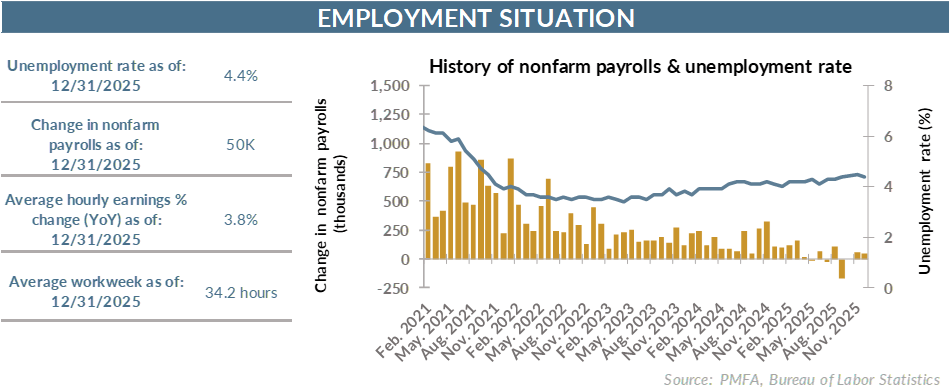
- Unemployment slipped to 4.4%, down from 4.6% in November, and unexpectedly better than the consensus forecast for a fractional decline to 4.5%. Under most circumstances, joblessness in the low 4% range would seemingly reflect solid labor conditions, but that’s only part of the story.
- The nuance comes in the so-called “curious balance” in labor conditions, as characterized by Fed Chair Jay Powell last year. Job creation has been mediocre at best in recent months, averaging -22,000 since October on a revised basis, the 50,000 December gain notwithstanding.
- Notably, that negative tilt was heavily skewed by the loss of 174,000 government jobs in October, a one-time hit reflecting the considerable number of federal workers that accepted buyouts earlier in the year.
- Private sector hiring has remained modestly positive, although choppy, in recent months. Even so, those gains were heavily concentrated in a few areas of the service economy — far from the broad cross-sectoral hiring trends reflective of an economy that’s firing on all cylinders.
- What’s holding unemployment in check? Stagnation in population growth and a moderation in labor force participation. Absent those factors, the jobless rate would likely still be edging higher as it has over much of the past few years.
- With a very meaningful influence on consumption and, in turn, overall economic momentum, lackluster job creation does create a risk to continued positive momentum for the economy. Offsetting that concern is the relative strength of wage growth, its 3.8% year-on-year increase providing decent fuel for continued household spending. Productivity has also surged, suggesting that employers are getting more out of their existing workforce and limiting any urgency to hire for the time being.
- Boil it down and the conflicting data provides reasonable arguments for both camps in the labor market debate: those who are justifiably concerned about limited hiring or outright job losses, and those that would argue that labor slack is limited and the current soft patch will pass if the economy maintains positive momentum.
Broad thoughts: Investors are upbeat as key policy-related decisions loom
- Stocks have come out of the gates in 2026 with positive momentum despite a flurry of concerning developments both in the United States and abroad that could have left investors a bit more wary than they are.
- The December jobs report could have been better, but it also certainly could have been worse. The immediate market reaction is telling. It was weak enough to convince investors that the case for further Fed rate cuts was strengthened, but not so bad to create real concerns that the economy is at heightened risk of stalling.
- Lower interest rates and solid GDP growth have provided a double dose of optimism for stocks, where solid earnings growth remains the expectation and lower rates could push more investors from cash and bonds into stocks in search of stronger returns.
- That doesn’t mean that the table is unambiguously set for placid stock market conditions. Additional Fed rate cuts are far from certain, and geopolitical tensions remain heightened. The looming Supreme Court decision over the Trump administration’s signature tariff package remains a major question on the fiscal front, although larger tax refunds in the coming months are expected to provide a boost to consumption.
- On the monetary front, a Fed pause at its January meeting still looks likely given indications that Q4 GDP was quite strong, and recent rate cuts have yet to be fully absorbed. Even though the changes in its voting membership could tilt the committee in a slightly more dovish direction, the hurdle for a fourth straight cut still looks relatively high.
- Despite its weak payroll numbers, the December jobs report wasn’t likely bad enough to convince policymakers to deliver another rate cut this month. That could set up the Fed’s March meeting to be the one to watch.
Media Mention:
Our experts were recently quoted on this topic in the following publication:
Past performance does not guarantee future results. All investments include risk and have the potential for loss as well as gain.
Data sources for peer group comparisons, returns, and standard statistical data are provided by the sources referenced and are based on data obtained from recognized statistical services or other sources believed to be reliable. However, some or all of the information has not been verified prior to the analysis, and we do not make any representations as to its accuracy or completeness. Any analysis nonfactual in nature constitutes only current opinions, which are subject to change. Benchmarks or indices are included for information purposes only to reflect the current market environment; no index is a directly tradable investment. There may be instances when consultant opinions regarding any fundamental or quantitative analysis may not agree.
Plante Moran Financial Advisors (PMFA) publishes this update to convey general information about market conditions and not for the purpose of providing investment advice. Investment in any of the companies or sectors mentioned herein may not be appropriate for you. You should consult a representative from PMFA for investment advice regarding your own situation.


