


Predicting what customers want feels tougher than it did a few years ago. Many consumers are prioritizing practical purchases and thinking twice before reaching for anything that feels optional. For businesses, this requires paying closer attention to changes in demand and a willingness to adjust cost strategies quickly. The pressure comes from multiple directions. More people are working from home, childcare costs continue to rise, and health-focused diets are shaping grocery lists. Added to this is the ease of online price comparison. The internet has empowered shoppers to instantly compare prices across multiple outlets, both online and in-store, before making a purchase. This transparency keeps retailers and brands on their toes, as price differences are quickly noticed and shared on social media or review sites. As a result, companies must not only monitor competitors more closely but also ensure their cost structures are efficient enough to support competitive pricing. Together, these circumstances have left shoppers more cautious than ever. They search for value, compare options, and often turn to social media for validation before buying, which makes predictions even more complex.
This heightened price sensitivity isn’t just a reaction to inflation but results from higher price levels that have become the “new normal.” As consumers scrutinize every purchase, retailers are doubling down on their resistance to price increases, intensifying the pressure on suppliers and manufacturers to protect already thin margins.
What does this mean? Consumers are more likely to seek out a deal or postpone purchases unless they deem them “worth it.” Whether consumers realize it or not, this nebulous demand influences how items are priced, how costs are distributed, and which products brands choose to offer in order to keep them moving off the shelves.
Whether your company is a startup with a simple operation or a billion-dollar global enterprise specializing in products — such as wipes, sunglasses, and more — accurate cost and margin information is critical to cash flow, profitability, and competitiveness. Often, companies believe they’re using correct cost data to make decisions but end up disappointed by the results. using correct cost data to make decisions but end up disappointed by the results.
Curious on how to improve your costing strategy? Start by ensuring your costing model reflects what you’re selling right now, not just predictions based on what you sold in the past.
Common signs of cost and margin intelligence
Consider a company that’s experiencing significant growth in production volumes and net revenue, except margins are lower than expected, or even shrinking. Executives are surprised by the poor results, and the chief financial officer can’t explain why. The executives are asking, “With good customers and contracts, why are margins shrinking?” The answer may be that new contract pricing was based on incorrect costs because the management team didn’t fully understand their cost drivers. Here are some examples:
- Overhead costs are spread like “peanut butter,” incorrectly burdening low-complexity SKUs and unknowingly favoring others.
- Due to product lead times, some consumer products — like specialized components or packaging — must be warehoused for extended periods. This takes up space needed for high-turnover items and adds extra costs. When these warehousing expenses are grouped into “peanut butter” overhead, all SKUs are affected, regardless of their sales velocity.
- Sales commits to ship directly to remote stores to secure a retailer’s business and doesn’t factor in LTL freight to the cost/price.
- The product is produced on an expensive and highly automated line, but overhead is applied using labor time, causing SKUs produced on this line to be undercosted.
- Labor and overhead costs are often applied evenly to each unit, even though different SKUs may need different crew sizes or production rates. For instance, a product requiring 10 operators gets the same per-unit cost as one needing only two, resulting in inaccurate cost estimates.
In the examples above, CFOs lack the data or the experience to properly assign costs. They don’t understand the company’s cost structure and therefore lose visibility of where they’re making and losing money.
Root causes of low or shrinking consumer product margins
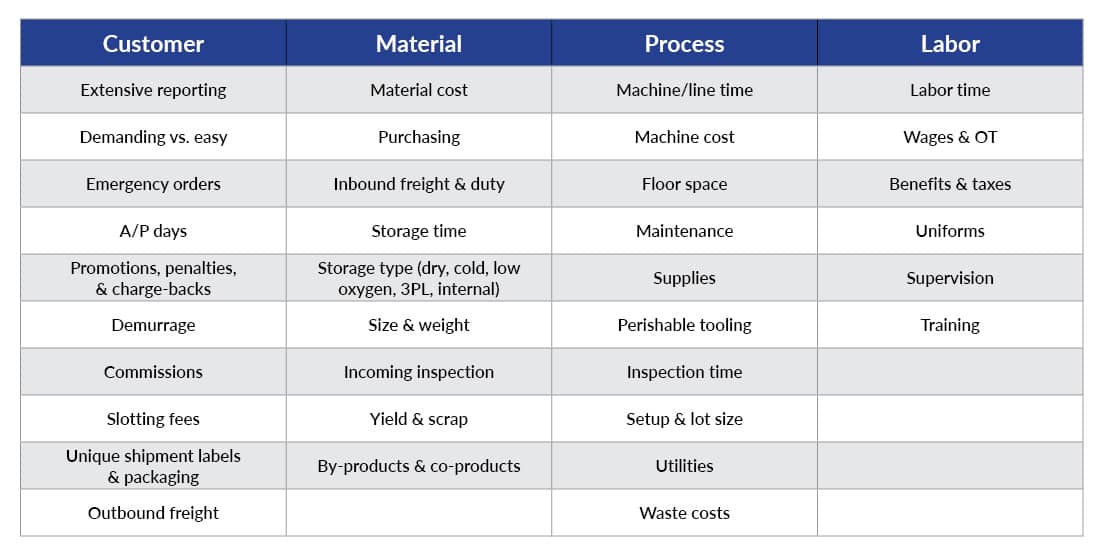
Many growing companies fight for shelf space with major retailers, and these contracts are critical to cash flow, brand visibility, and success. When revenue rises but margins unexpectedly shrink as the business fulfills customer orders, it often means the company isn’t accounting for all the costs necessary to serve the retail customer. To understand true margin (not just gross margin), consumer product organizations need to incorporate all the costs to serve — customer, material, process, and labor costs — into their costing models. Take a look at our diagram of key cost drivers:
Greater insight enables greater control
When cost information is incomplete, pricing decisions become guesswork and margin performance follows. An informed approach to costing gives your company control when negotiating customer pricing. It helps you to understand how low (or high) they can quote a strategic opportunity, and enables them to proactively manage margins and on a real-time basis determine price increases. When you have this information, you can set prices accurately and better manage profits, especially when things change or costs rise. This is how you stay competitive in the market.
A clear understanding of the true cost-to-serve expenses changes things, showing how each customer relationship performs over time and how much flexibility there is when considering new opportunities. It also helps leaders adapt to market changes without making any drastic moves.
While companies can attempt to update their costing models independently by reviewing processes and leveraging available analytics, they may be limited by gaps in expertise or perspective. Engaging specialists or industry consultants can accelerate improvements and uncover hidden cost drivers to develop a framework for greater visibility. You may not control the next consumer product trend, but you can control how prepared your pricing strategy is to respond.


