


As an executive leader, you’re accountable for technology outcomes, not technology activity. You’ve approved the budgets, you’ve hired the teams, and you’ve selected the vendors. And yet ERP implementations drag past their deadlines, cybersecurity programs operate without clear portfolio visibility, M&A acquisitions aren’t sufficiently integrated, AI initiatives stall before they reach production, and no one in the room can provide a clear answer about where things stand. The problem, more often than not, isn’t the technology or even the resources supporting projects, but the governance around it.
Most organizations have a project management office (PMO) to govern project delivery. But a PMO was intended for projects broadly — not for the particular depth and complexity that technology demands. When your portfolio includes an IT integration initiative, ERP modernization, an AI integration, a cybersecurity overhaul, and an analytics buildout running simultaneously, you need a governance function that can go further than tracking RYG status and milestone dates. You need a function that understands what’s happening inside those initiatives and can lead you to better outcomes because of it.
That function is the technology project office (TPO), and if your organization doesn’t have one, it’s likely costing you more than you realize.
What is a TPO?
A technology project office is a centralized governance function built specifically to oversee the delivery of technology-focused initiatives across your organization. It serves as the connective tissue between your IT teams, your business stakeholders, your executive leadership, and your vendors — making sure that everyone is working toward the same outcomes and that the complexity living inside your technology programs is being actively managed, not just monitored.
Where a traditional PMO operates at the project level — tracking schedules, budgets, and resource plans — a TPO operates at the intersection of project delivery and technical execution. The TPO develops comprehensive project plans, manages budgets, and oversees resource allocation for all technical workstreams. They’ll also integrate these details into the broader PMO program, ensuring that technical complexities are reflected accurately within the overall project portfolio.
They understand the architecture decisions that are being made. They can evaluate whether a vendor is delivering what was contracted and identify a data migration risk before go-live. The TPO translates technical complexity into strategic language that leadership understands and priorities into technical requirements that delivery teams can execute against.
Think of it this way: The PMO tells you the train is running late, but the TPO tells you why the engine is failing and has an engineer on the phone, ready to step in.
Governance and accountability
Without clear governance, technology projects drift in ways that are hard to see until the damage is done. A TPO establishes the decision rights, documentation standards, and escalation paths that prevent this kind of degradation. They ensure that every initiative has an accountable owner, that decisions are made by the right people with the right information, and that the organization can course-correct quickly rather than discovering problems later. A TPO doesn’t just manage technology projects— they govern the technical complexity inside them, which is where most organizations lose the ground.
Portfolio visibility and prioritization
Your technology portfolio is almost certainly larger and more interdependent than any single leader’s view of it. A TPO creates the consolidated visibility that executive leadership needs to make sound decisions — not just about individual projects, but about how they relate to each other. When a new request enters the pipeline, the TPO gives you the context to evaluate it honestly. When a project stalls, the TPO surfaces the downstream impact before it compounds.
Standardized methodology and tooling
Inconsistency is one of the most common and underappreciated sources of project failure. When different teams operate with different processes, tools, and definitions of what a milestone means, coordination breaks down and reporting becomes unreliable. A TPO establishes a shared methodology — whether Agile, Waterfall, or a thoughtfully designed hybrid — along with the tooling, templates, and reporting cadences that create a common baseline across every initiative in the portfolio. This creates the shared language and structure that allows teams to move faster.
Risk and issue management
Every technology program carries risk. Integration failures of some sort. A TPO builds the proactive risk discipline that most organizations lack: identifying risks early, maintaining mitigation plans before issues escalate, and ensuring that problems surface through appropriate channels rather than being managed quietly at the project level until they become crises. Organizations with a functioning TPO don’t eliminate risk — but they encounter far fewer surprises, and they recover from the ones they do encounter faster.
Stakeholder communication and alignment
Poor communication between technology teams and business leadership creates frustration as much as strategic liability. When executives are surprised by delays, when business stakeholders feel uninformed about systems that affect their operations, and when technical teams operate without clear signals about shifting organizational priorities, the result is misalignment that slows delivery and erodes trust. The TPO owns the communication infrastructure that prevents this: executive reporting, steering committee governance, cross-functional coordination, and the translation work that ensures technical realities and business expectations stay aligned throughout every phase of delivery.
The PMO vs. the TPO: Why the distinction matters
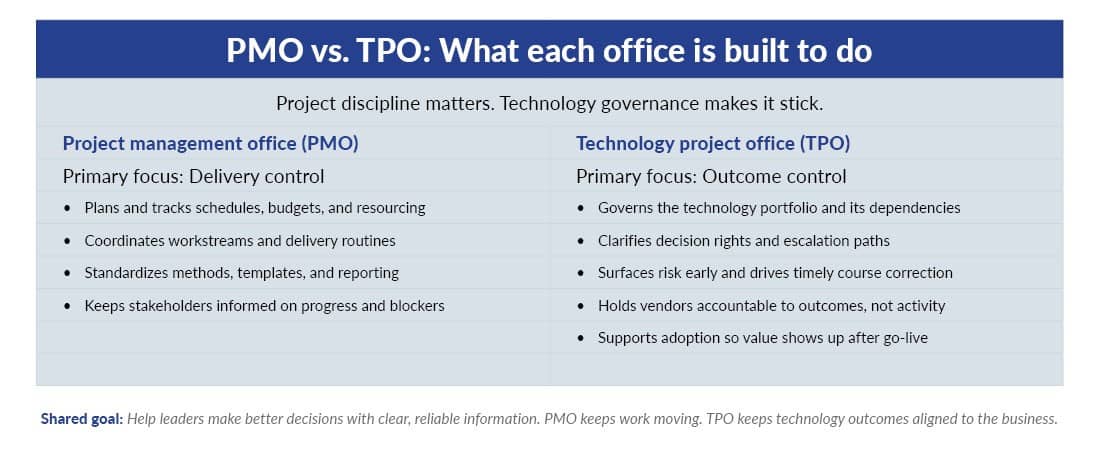
Most organizations already have some version of a PMO — and if yours does, that’s a good thing. The PMO has long been the standard for enterprise project governance. But the lack of technology/technical aptitude within the traditional PMO consistently reaches the edge of its capability, and that category is technology.
By applying years of technical project implementation and aptitude related to IT services, business analytics, enterprise applications, M&A requirements (separation, integration, remediation, and consolidation), and cybersecurity domain, the TPO is a super-charged version of the project management office.
One governance structure, every technical domain
What makes the TPO model valuable is that it doesn’t require a separate governance structure for each domain. Your ERP program, your IT integration and AI initiatives, your cybersecurity portfolio, and your analytics investments all operate under the same governance umbrella — while still receiving the domain-specific technical attention each one requires. This unified approach eliminates the fragmentation that occurs when different technology programs are governed in isolation and surfaces interdependencies before they become conflicts.
Your PMO remains essential for enterprise project governance. But when technology is the work — when the complexity lives inside the systems, the integrations, the data, and the architecture — the TPO is the function which ensures that complexity is governed with the expertise it demands.
Getting started
If you’re evaluating whether a TPO is right for your organization, the most useful first step is an honest assessment of your current state. How well are your technology projects being governed today? What does your on-time, on-budget delivery rate look like? Do your business stakeholders trust the information they receive about technology programs that affect their operations? Most organizations that work through these questions candidly find that the gaps are larger than expected and that the accumulated cost of operating without technology governance is higher than the cost of building the capability to govern it. A TPO addresses the key gaps that appear as organizations grow. It translates technical details for executives and adapt governance to support a range of projects. It also ensures that vendors are held accountable for more than just status updates. Without this role, organizations often see project overruns, poor portfolio visibility, and technology investments that don’t align with priorities.
A TPO isn’t an administrative overhead function. Done right, it’s one of the highest-leverage investments your organization can make in its ability to execute on the technology agenda your strategy demands. And with a partner with industry specific knowledge beside you, you don’t have to build that capability from zero.


