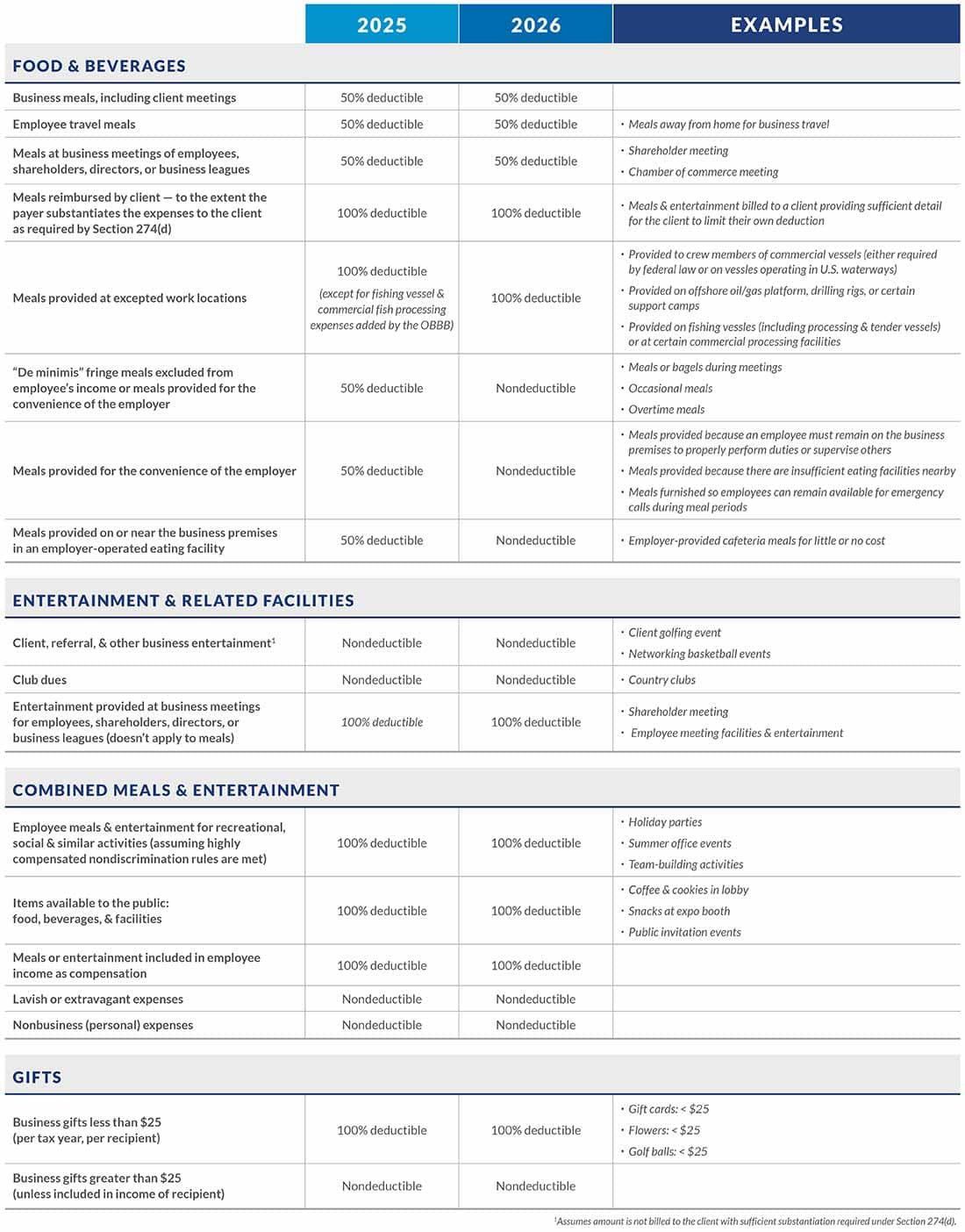
Business deductions for meals and entertainment (M&E) expenses are a surprisingly complex area of the Tax Code. At their core, such rules reflect an inherent challenge in separating expenses that are business in nature from those that are, to at least some degree, something else. Accordingly, such rules overlap with employee compensation and benefits as well as personal expenses. The complexity is amplified as Congress periodically revises such rules to either provide economic support to businesses through enhanced deductions or to curtail such deductions. More specifically, Congress has modified such rules at least three times since 2017. So, what’s the state of M&E deductions in 2026? We sort through the shifting rules to clarify what’s new for 2026 and what remains the same as last year.
- Legislative changes leading to 2026
- Denial of deductions related to employer-operating eating facilities
- Meals for the convenience of the employer are nondeductible
- What didn’t change?
Legislative changes leading to 2026
Over the past several years, there have been numerous changes to the deductibility of meals and entertainment expenses. These rules are largely found in Section 274 but include cross-references to several other sections of the Code. A summary of legislative activity includes the following:
- TCJA. The Tax Cuts and Jobs Act (TCJA) was enacted in 2017 and made substantial changes to the Tax Code. While that law focused on reducing tax burdens on businesses and individuals, not all changes involved tax cuts. Instead, Congress balanced lower tax rates and enhancements to some deductions with new limitations on other deductions. In summary form, the TCJA made business entertainment entirely nondeductible, reduced most business meal deductions to 50%, and modified other rules related to employee fringe benefits, all beginning in 2018. Importantly, the TCJA also made additional business meals nondeductible on deferred basis, with 2026 being the applicable year. Such meals were scheduled to include company cafeteria expenses, meals provided for the convenience of the employer, and occasional meals qualifying as de minimis fringe deductions.
- COVID-19 era. During the COVID-19 pandemic, Congress looked to M&E deductions as a way to provide further business stimulus. Thus, a temporary 100% deduction was allowed for meals provided by a restaurant. However, that deduction lapsed at the end of 2022.
- OBBB. Most recently, the One, Big, Beautiful Bill (OBBB) made additional changes to the M&E rules. These were narrow in scope and largely modified the TCJA changes that were scheduled to take effect in 2026.
The continuing evolution of such rules can understandably lead to confusion. The below analysis is intended to provide clarity about the rules applicable to 2026 and beyond.
Denial of deductions related to employer-operated eating facilities
Some businesses maintain eating facilities at or near their business premises to provide meals for employees or a combination of employees and nonemployees. The TCJA imposed a new rule for 2026, which generally disallows deductions related to such meals. However, the OBBB also expanded the exceptions to this rule. Key aspects of this deduction disallowance include:
- Applicable facilities. For this purpose, an employer-provided eating facility is generally defined as one that is: (1) located on or near the business premises of the employer, and (2) revenue derived from such facility normally equals or exceeds the direct operating costs of such facility.
- Disallowed expenses. Businesses are unable to deduct any expense for the operation of the facility and any expense for food or beverage associated with such facility. This includes any food or beverages that would otherwise qualify as de minimis fringe benefits for employees.
- Exceptions. Key exceptions to the expense denial were provided by the TCJA and supplemented by the OBBB. These allow expenses to remain fully deductible if adequate and full consideration is paid for the food and beverages provided, or the expenses are for food and beverages provided to workers on certain commercial vessels or oil and gas platforms. An additional exception was provided for restaurant employee meals under Treasury Regulation Section 1.274-12(c)(2)(v)(A).
This change significantly impacts businesses that operate eating facilities on the premises given the associated costs. However, the exceptions to this rule are notable and worth careful consideration. Unfortunately, these are generally tied to specific industries and places of business so they’re not expected to be widely applicable across the economy.
Meals for the convenience of the employer are nondeductible
Businesses also provide meals to employees for various reasons. One such reason is the convenience of the employer (e.g., furnishing meals to maintain productivity). From the perspective of the employee, meals provided on business premises that are for the convenience of the employer are excluded from compensation under Section 119(a). However, beginning in 2026, such meals are nondeductible by the employer.
- Applicable meals — For this purpose, disallowed meal expenses are those that: (1) are provided on the business premises of the employer, and (2) are for the convenience of such employer.
- Exceptions — The same exceptions as discussed above apply in this case. Importantly, this means that expenses related to meals sold to employees for appropriate consideration remain deductible. Moreover, deductions are available for meals in the case of commercial vessels, offshore oil or gas platforms and drilling rigs, fishing vessels, or certain fish processing facilities.
The impact of this change is expected to be felt across nearly all businesses given the pervasive nature of meals and snacks within business environments.
What didn’t change?
Other rules relating to business M&E didn’t change for 2026, including the following:
- Fully deductible meals and entertainment. The following meals and entertainment expenses remain fully deductible:
- Expenses for recreational, social, or similar activities for the benefit of employees.
- Expenses treated as Form W-2 employee compensation or includible in the income of nonemployees.
- Expenses for goods and services which are sold by the taxpayer in a bona fide transaction for full and adequate consideration.
- Expenses for goods, services, and facilities made available by the taxpayer to the general public.
- Going forward, the most common 100% deductible meals and entertainment will often relate to expenses for recreational, social, or similar activities for the benefit of employees. This provision is often applied to holiday parties, summer outings, and retirement lunches. However, these expenditures must satisfy highly compensated employee nondiscrimination requirements.
- 50% deduction for business meals. Business meals that aren’t disallowed under the above rules generally result in a 50% tax deduction. Those include:
- Meals with clients where an employee or representative of the business is present.
- Meals related to business travel.
- Certain office snacks and beverages that aren’t considered meals and aren’t related to employer-operated eating facilities.
- Entertainment. These expenses remain nondeductible as they have been since enactment of the TCJA. This includes various activities, such as golfing with clients or networking at sporting events. However, meals that are separately charged from entertainment may be 50% deductible.