


Ask a successful family what prosperity means to them and the answer will usually go well beyond financial achievement. For many, it includes raising children and grandchildren who are confident, grounded, generous, and able to make thoughtful decisions. Yet, the same resources that create opportunity can also create confusion, comparison, and pressure, especially for kids. That tension is even more pronounced today, given how dramatically the financial environment around children has changed.
What’s changed for kids today?
The fundamentals of financial education haven’t changed. Children still need to learn needs versus wants, saving, giving, and making financial trade-offs. What has changed is the environment. Today’s children grow up with social media, influencer culture, one-click purchases, in-app spending, stored cards, and digital wallets. Money feels immediate, invisible, and disconnected from effort.
For families of wealth, this environment can be especially challenging. Luxury travel, homes, experiences, clothing, and technology may appear “normal” to kids both online and in daily life.
Social media can intensify comparison and obscure the effort, values, and trade-offs behind what children see. Digital money further blurs reality because money doesn’t physically leave their hands.
This is why social media and digital spending shouldn’t be treated as separate parenting issues; they’re now part of financial education itself. A child who learns to pause before buying an app upgrade, question why an influencer makes something look necessary, or connect an online purchase to a real budget is practicing the same judgment they’ll eventually need for larger financial decisions.
Start early for a solid financial education
When preparing future generations to become good stewards of family wealth, one of the most frequently asked questions is, “When and how do we start talking to our kids about money?” In most cases, the answer is, “Earlier than you think.” You can begin with simple, age-appropriate conversations long before children understand balance sheets, trusts, investments, or inheritance. In fact, waiting too long increases the chance they’ve already absorbed messages from peers, social media, advertising, and family behavior.
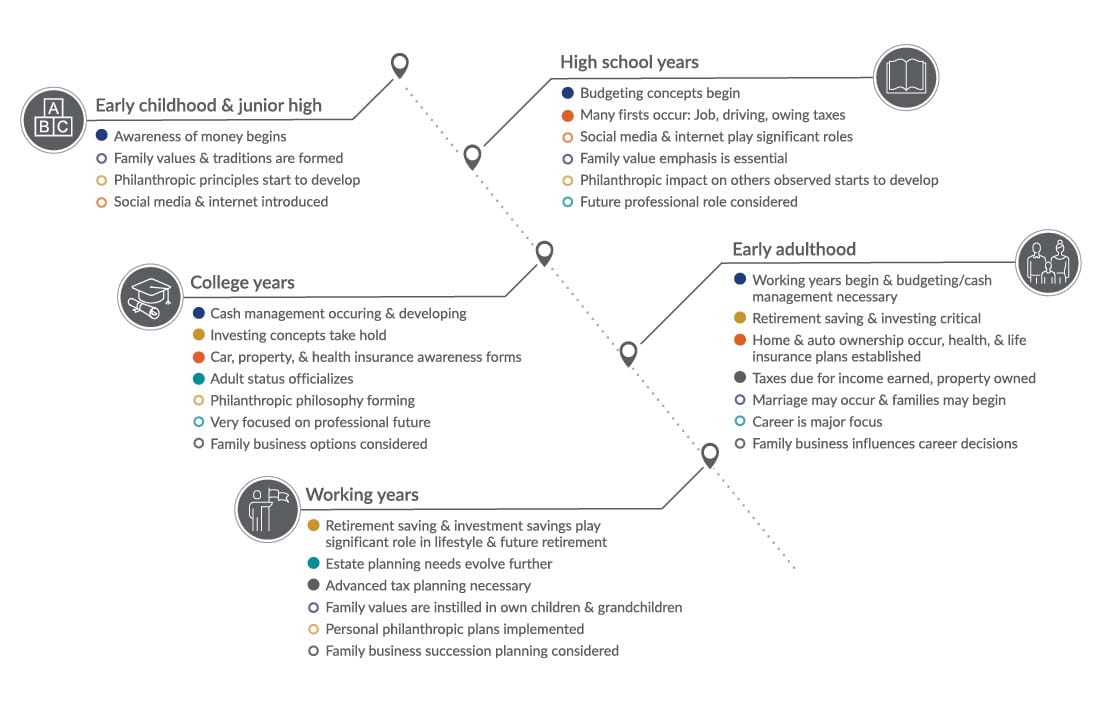
In terms of “how,” the approach is simple: Start early, keep it age-appropriate, and make it relevant to real life. For school-aged children, that may mean practicing spending decisions at a store or discussing why every advertised item isn’t a need. For teenagers, it may mean talking about online spending, debit cards, peer comparison, charitable giving, and the responsibility that comes with access to family resources. For young adults, it may mean practicing budgeting, investing, borrowing, taxes, and participation in family enterprises or philanthropic decision-making.
The chart below identifies a timeline based on age groups with some recommended areas of focus.
When considering activities to reinforce these concepts, look for ideas that make money lessons part of everyday life. A family history project that includes a family tree, old pictures, and a simple timeline can open conversations about work, sacrifice, education, opportunity, and values, helping children see that family resources have a history and a purpose, not just a balance.
The “spend, save, share” method encourages kids to divide money into three buckets: spending, saving, and giving. In a digital world, families can make this even more visible by reviewing purchases together, showing how small online transactions add up, and connecting each purchase back to the child’s goals. As children get older, families can add a “tax” bucket to prepare them for their first paycheck.
As children mature, the lessons should mature with them. College students and recent college graduates can prepare a plan for investing in their first Roth IRA or 401(k) plans, perhaps by working with a financial advisor of a similar age to walk through the basics of long-term financial planning. This may also be a good time to introduce inheritance, estate planning concepts, and create their first will.
As kids move into their 30s and beyond, it may be time to deepen participation in family enterprises such as a business, an investment committee, or foundation board — situations that require application of advanced decision-making and real-world financial skills.
Whatever the age, look for opportunities to pair money lessons with conversations about family history, expectations, roles, purpose, and responsibility. For multigenerational families, the goal isn’t merely to raise children who can manage money. It’s to raise children who understand what the wealth is for, what responsibilities come with it, and how their choices affect themselves, their family, and their community.
A proven approach for establishing good financial literacy
When teaching your kids about money, a simple and effective teaching method is “theory, example, application.” Explain the concept, illustrate it, then let the child apply it in a real-world decision. To teach that digital money is still real money, explain how a stored card works, show how small purchases appear on a statement, and ask the child which purchase they’d make if it came from their own spending bucket.
Over time, these conversations can expand naturally to values based spending, income, budgeting, investing, borrowing, taxes, charitable giving, and responsible technology use. The point isn’t to lecture children into perfect financial behavior. It’s to give them repeated practice making decisions, seeing consequences, and developing judgment before the decisions become larger.
Tips for a successful financial education
Financial literacy isn’t a “check-the-box” list of technical information. It’s an ongoing process of values based experiences that influence how children think about wealth, work, risk, opportunity, and responsibility. To make those experiences more practical and more likely to stick, consider the following:
- Set boundaries. Boundaries help children understand that access isn’t the same as entitlement. For younger children, this might mean limits on treats, toys, or screen time. For older children, it might mean limits on app purchases, food delivery, travel spending, or parent-funded lifestyle expenses.
- Practice delayed gratification. Waiting builds the pause that thoughtful decisions require. In a one-click world, this is hard. Try asking a child to save for part of a purchase, wait 24 hours before buying something online, or compare alternatives to help build in a pause.
- Allow mistakes. Low-stakes errors create memorable lessons — a regretted purchase, a depleted allowance, or a missed savings goal. Resist the urge to rescue too quickly and use mistakes as coaching moments.
- Talk about social media. Children are constantly exposed to curated lifestyles, influencer recommendations, and peer spending. You can help by asking simple questions: “What is this post trying to make you want?” “Is this person being paid to promote something?” “Would this purchase matter to you tomorrow?”
- Make digital money visible. Review online purchases and running totals together to connect invisible spending to real money.
- Model good financial behaviors. Kids watch how adults spend, save, and moderate. Perhaps the simplest way to instill good habits is by demonstrating them yourself — and not only demonstrating but explaining the reasoning behind your actions.
Financial literacy accumulates over time
Financial literacy succeeds when families commit time, attention, and repeated practice. Start early with age-appropriate conversations and real-life decisions. Give children room to try, decide, wait, give, save, spend, and sometimes make mistakes. For families of wealth, the goal is bigger than teaching kids to manage money. It’s preparing capable stewards who understand the purpose, privilege, and responsibility that comes with family resources.
Key takeaways
- Financial literacy begins earlier than most families expect. Children absorb messages about money long before they understand accounts, investments, or inheritance, especially through peers, social media, and family behavior.
- Digital money and social media are now part of financial education. Invisible spending, one‑click purchases, and curated online lifestyles shape how children perceive money, value, and comparison.
- Start teaching children with small, real-life decisions, and give them room to practice. Age-appropriate choices, boundaries, and even low-stakes mistakes help children build the judgment they’ll need long before the financial stakes grow.
- Values matter as much as mechanics. Effective financial education connects money to purpose, responsibility, family history, and the role wealth plays in a child’s life and community.
- Financial literacy evolves across life stages. As children mature, lessons should expand to budgeting, investing, taxes, charitable giving, and eventually participation in family enterprises or governance.
- The ultimate goal is stewardship, not just competence. Families of wealth succeed when future generations understand not only how to manage money, but why the wealth exists and how to use it with judgment and purpose.


